
Can Existing Wood Newel Posts Be Reused in a Stair Remodel?
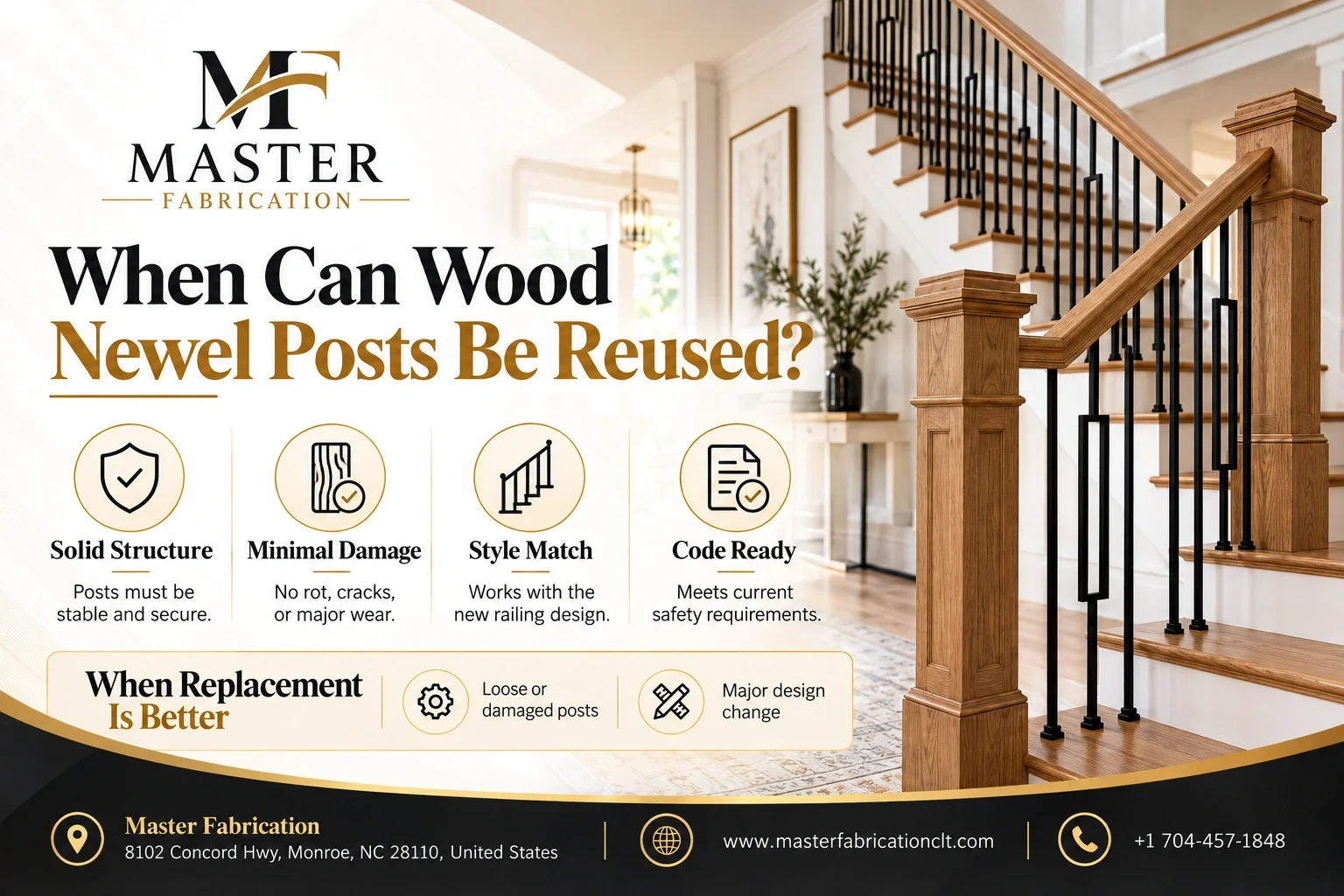
Existing wood newel posts can sometimes be reused during a stair remodel if they are structurally sound, securely installed, and compatible with the new railing design. In other cases, replacement may be the better option because the posts are damaged, poorly positioned, too small for the new system, or visually inconsistent with the updated staircase.
At Master Fabrication, we recommend evaluating the existing posts before making assumptions about whether they should stay. Reuse can work well in the right situation, but the decision should be based on condition, structural suitability, compatibility, design, and the overall scope of the remodel.
Can Existing Wood Newel Posts Be Reused in a Stair Remodel?
Yes, some wood newel posts can remain in place during a stair remodel.
This is often possible when the existing posts are still solid and the new railing can be connected to them appropriately.
A homeowner may want to keep the newels because they:
Match the staircase
Coordinate with existing trim or flooring
Are made from quality wood
Have architectural character
Are still in good condition
Fit the planned railing design
Reusing them can also help preserve part of the original staircase while other components are updated.
However, a newel post should not be kept simply because it looks acceptable from the outside. It also needs to function properly as part of the new railing system.
The post's attachment, location, size, condition, and relationship to new balusters or handrails all need to be considered.
How Do You Evaluate the Condition of a Newel Post?
Condition is one of the most important factors when deciding whether a newel can stay.
The post should be checked for both visible and less obvious problems.
Common issues include:
Cracks
Splitting
Rot or moisture damage
Loose movement
Failed joints
Damage from previous fasteners
Dents or heavy wear
Previous repairs
Warping
Weak attachment points
Cosmetic wear does not always mean the post needs replacement.
Surface scratches, faded stain, or minor imperfections may be correctable through refinishing.
Movement is more concerning.
A newel post that shifts noticeably when pressure is applied may have a problem with the post itself, its attachment, or the surrounding stair structure.
The remodel is a good opportunity to assess these conditions before installing new railing components around them.
Why Does the Structural Role of the Newel Matter?
A newel post is more than a decorative element.
It often plays an important structural role within the railing system by supporting handrails, anchoring transitions, and helping keep the railing stable.
Newels are commonly found at:
The bottom of a staircase
The top of a staircase
Landings
Turns
Transitions between railing sections
Because of that role, the post needs to be capable of supporting the updated system.
Even a visually attractive wood newel may not be suitable for reuse if its attachment is weak or its position does not work with the new railing layout.
This is one reason homeowners should avoid treating newels as isolated design pieces.
The post, handrail, balusters, mounting points, and surrounding staircase all work together.
At Master Fabrication, we look at whether the existing newel can function effectively within the redesigned railing rather than focusing only on its appearance.
Will Existing Newel Posts Work With New Balusters?
Sometimes, but compatibility is not automatic.
New balusters may have different dimensions, connection methods, spacing requirements, or visual proportions than the original railing.
The existing newels need to work with those changes.
Important factors include:
Baluster size
Baluster spacing
Handrail position
Post width
Post height
Connection details
Stair angle
Landing configuration
Overall railing style
A traditional wood newel can work well with updated metal balusters in many designs.
This combination is common when homeowners want to modernize the railing without removing all of the original woodwork.
However, the new balusters should not look undersized, crowded, or awkward next to the existing posts.
The connection details also need to make sense structurally.
Design decisions should therefore be made around the complete railing system instead of selecting new balusters without considering the existing newels.
Does Newel Post Size Affect Compatibility?
Yes.
The dimensions of the existing newel can influence whether it works with a new railing design.
A large traditional post may feel visually heavy next to very slim modern metalwork.
A small post may not provide the proportions or connection area needed for a larger handrail or more substantial railing system.
Size can affect:
Visual balance
Handrail connections
Baluster spacing near the post
Hardware placement
Alignment
Transition details
Height also matters.
The post needs to work with the planned handrail position and the overall stair layout.
In some remodels, the existing post may technically be reusable but look out of scale with the new design.
In those cases, replacement can improve the overall appearance even if the old post is still structurally sound.
Can Old Wood Newels Be Refinished or Restained?
Yes, provided the wood is in suitable condition.
Refinishing can be a good option when the post itself is worth keeping but its appearance no longer matches the updated staircase.
Homeowners may be able to change:
Stain color
Paint color
Sheen
Surface tone
Overall finish appearance
This can help an older newel coordinate with new flooring, stair treads, handrails, or metal balusters.
Refinishing can also highlight the character of an original wood post that would otherwise be lost through replacement.
However, not every old finish is easy to change.
Previous paint, stain, coatings, deep damage, or inconsistent wood color can affect the refinishing process.
If the goal is to match another wood surface exactly, homeowners should also understand that existing and new wood may absorb stain differently.
It may be more realistic to coordinate finishes rather than expect a perfect match.
When Is Replacement a Better Option?
Replacing the newel post may make more sense when the existing component creates structural, compatibility, or design problems.
Replacement may be worth considering when:
The post is loose
The wood is cracked or damaged
The attachment is unreliable
The post has significant moisture damage
Previous modifications have weakened it
The dimensions do not suit the new railing
The style conflicts with the remodel
The post is positioned poorly
Adapting it would require extensive modification
A homeowner may also choose replacement when the remodel is intended to create a significantly different look.
For example, a highly ornate wood newel may not fit a very simple contemporary railing.
Keeping it could make the new system look like separate old and new pieces rather than one coordinated design.
In those situations, replacement can help create a more intentional result.
How Does Reusing Newel Posts Affect the Overall Design?
Keeping existing wood newels can influence the direction of the entire stair remodel.
They may become a bridge between the original architecture and the new railing.
For example, a wood newel paired with metal balusters can create a balanced mixed-material look.
Reuse works particularly well when the posts:
Match existing stair treads
Coordinate with flooring
Complement nearby trim
Have proportions that suit the new railing
Contribute character to the staircase
However, the opposite can also happen.
An old post that is oversized, heavily decorative, or poorly matched to the new railing may make the update feel incomplete.
The question is not whether old and new materials can be mixed. They often can.
The real question is whether they look intentional together.
At Master Fabrication, we recommend looking at the entire staircase before deciding which original components should remain.
Can Reusing Existing Newels Reduce Remodel Costs?
It can, but not in every case.
Keeping a structurally sound newel may reduce the amount of new material and replacement work included in the project.
However, reuse may still involve:
Careful removal of old railing components
Repair work
Refinishing
Modifying connections
Adapting new balusters or handrails
Addressing previous damage
If the existing posts require extensive repair or modification, the savings may be smaller than expected.
In some situations, replacing a complicated or unsuitable post may simplify the rest of the railing project.
That is why homeowners should compare the complete scope rather than assuming reuse will automatically be less expensive.
The better question is whether keeping the post makes sense structurally, visually, and financially.
How to Decide Whether to Keep or Replace Your Newel Posts
The decision becomes easier when several factors are considered together.
Check the Structural Condition
The post should feel solid and securely attached. Significant looseness, damage, or deterioration may point toward replacement.
Review Compatibility
Make sure the post works with the new handrail, balusters, dimensions, and connection details.
Consider the Size
Look at whether the existing post is visually and physically appropriate for the new railing system.
Evaluate the Finish
If the post is structurally sound but looks dated, refinishing may solve the problem.
Look at the Whole Staircase
Think about how the post relates to the flooring, treads, handrail, balusters, walls, and nearby finishes.
Compare the Scope and Cost
Consider the work required to repair, refinish, or adapt the existing post versus installing a new one.
Decide How Much Change You Want
If the goal is a light update, keeping the original newels may work very well. If the goal is a major design transformation, replacement may help create a more consistent result.
There is no single answer for every stair remodel.
The right decision depends on what is already there and how the new railing is being designed.
FAQs
Can you replace balusters and keep the existing newel posts?
Yes, in many cases. Existing newels may work with new balusters if the posts are structurally sound, properly located, and compatible with the new railing system.
Can old wood newels be used with metal balusters?
Yes. Wood newels and metal balusters can work well together when their size, spacing, finish, and overall design are coordinated.
Should a loose newel post be reused?
A loose post should be evaluated before it is reused. The cause of the movement needs to be understood and corrected as part of the project.
Is refinishing a newel cheaper than replacing it?
It can be, but the answer depends on the condition of the post and how much preparation, repair, or finish work is needed.
Can an old newel be painted instead of replaced?
Possibly. If the post is structurally sound, changing the finish may be enough to make it work with the updated railing.
Do all newel posts need to match?
Not necessarily. Different posts can sometimes be used intentionally, especially at transitions or landings, but the overall railing should still feel visually coordinated.
Keep the Parts That Still Work for the New Design
Reusing wood newel posts during a stair remodel can make sense when those posts are still strong, well-positioned, and compatible with the updated railing.
A good existing post does not necessarily need to be removed simply because the balusters or handrail are changing. Refinishing or adapting it may allow homeowners to preserve part of the original staircase while still giving the railing a fresh look.
Master Fabrication evaluates newel posts as part of the complete railing system. By considering structure, size, compatibility, finish, design, and project cost together, homeowners can decide whether keeping the existing newels adds value to the remodel or whether replacement will produce a better overall result.