
Does a Stair Railing Remodel Require Replacing the Handrail?
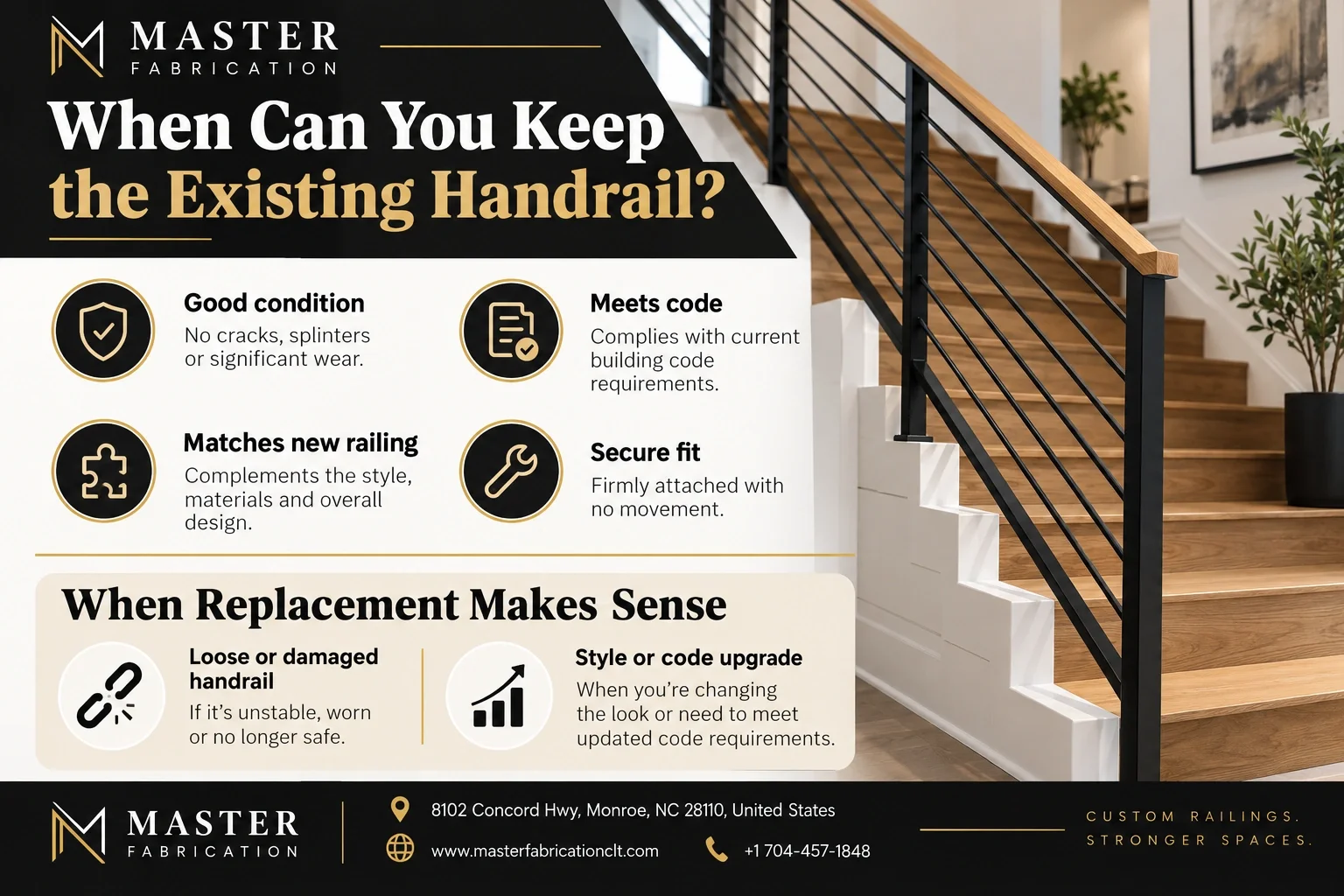
A stair railing remodel does not always require replacing the existing handrail. If the handrail is structurally sound, in good condition, and compatible with the new railing design, it may be possible to keep or refinish it instead.
In other cases, replacement makes more sense because the existing handrail is damaged, does not work with the new balusters or posts, or looks out of place with the updated design.
At Master Fabrication, we recommend evaluating the entire railing system before deciding. Condition, compatibility, finish, safety, design goals, and budget all affect whether the existing handrail should stay or be replaced.
Do You Have to Replace the Handrail During a Railing Remodel?
No. Replacing the handrail is not automatically required every time the rest of the railing is remodeled.
Some homeowners replace only the balusters or other railing components while keeping the existing handrail. This can work well when the handrail is still in good shape and fits the new design.
For example, a solid wood handrail may still work with updated metal balusters if the dimensions, attachment points, and overall style are compatible.
Keeping an existing handrail may also help preserve a feature that already matches other woodwork in the home.
However, it should not be kept simply to avoid replacing it. The handrail still needs to work properly with the updated railing system.
A professional evaluation can help determine whether reuse is practical before the rest of the design is finalized.
When Can an Existing Handrail Stay?
An existing handrail may be worth keeping when it meets several important conditions.
It should be:
Structurally sound
Securely mounted
Free from significant cracks or damage
Compatible with the planned railing design
Appropriate for the staircase layout
Able to accept the necessary railing connections
Visually suitable for the updated space
The handrail also needs to make sense in relation to the new balusters, posts, and surrounding finishes.
If a homeowner likes the handrail but wants a more modern look, replacing outdated balusters while keeping the handrail may be enough to create a noticeable change.
This approach can sometimes reduce the amount of material being replaced while preserving part of the home's existing character.
The key is compatibility. Even a well-maintained handrail may not be suitable if the new railing design requires different dimensions, connections, or support locations.
How Does Handrail Condition Affect the Decision?
Condition is one of the first things to evaluate.
An older handrail may look acceptable from a distance but still have issues that become more obvious once the rest of the railing is removed.
Look for problems such as:
Cracks
Splits
Loose sections
Significant dents
Water damage
Warping
Failing joints
Previous repairs
Heavy surface wear
Minor cosmetic wear does not necessarily mean replacement is required. Scratches, faded stain, or an outdated finish may be correctable through refinishing.
Structural damage is different.
If the handrail moves, flexes excessively, has damaged connection points, or has weakened over time, replacing it may be the more practical option.
A railing remodel is also a good opportunity to inspect areas that were difficult to see before the existing balusters or posts were removed.
Will the Existing Handrail Work With New Balusters?
Not always.
New balusters must connect properly with the handrail and the rest of the railing system.
Compatibility depends on factors such as:
Handrail width
Handrail depth
Existing grooves or channels
Baluster size
Baluster shape
Connection method
Spacing
Stair angle
Post configuration
An existing wood handrail may have been designed around a specific style of wooden baluster, for example. Installing a different metal baluster system may require another type of connection.
Sometimes the handrail can be adapted without significantly changing its appearance. In other cases, the modifications needed may make replacement more practical.
This is why railing components should be considered as a system rather than as separate decorative pieces.
Choosing new balusters first and assuming they will work with any existing handrail can create unnecessary complications later.
How Important Is Finish and Color Matching?
Very important, particularly when the handrail will remain visible beside new metalwork.
A technically compatible handrail can still look disconnected from the rest of the remodel if its finish does not relate well to the updated railing.
Consider how the existing handrail looks next to:
New metal balusters
New posts
Flooring
Stair treads
Wall colors
Door hardware
Light fixtures
Other wood finishes
The handrail does not have to match every surface exactly.
In fact, contrast can be intentional. A stained wood handrail paired with dark metal balusters can create a strong visual combination.
Problems are more likely when finishes appear unintentionally mismatched.
For example, an older orange-toned stain may clash with newly updated flooring or a modern metal railing.
In that situation, refinishing the handrail may provide a more cohesive result without requiring complete replacement.
Can an Older Handrail Be Refinished Instead of Replaced?
Yes, in some cases.
If the handrail is structurally sound but the finish looks dated or worn, refinishing may be a practical way to update its appearance.
Depending on the material and condition, refinishing may involve changing:
Stain color
Surface tone
Sheen
Paint color
Overall appearance
This can be useful when homeowners want to keep the shape and character of the existing handrail while making it work better with new railing components.
Refinishing is not always the simplest option, however.
Deep damage, previous coatings, difficult repairs, or incompatible materials can make refinishing more involved than expected.
The surrounding staircase also matters. If stair treads, flooring, or other woodwork are being updated, the handrail finish may need to coordinate with those materials as well.
Before deciding, compare the condition and refinishing requirements with the cost and design benefits of a new handrail.
When Does Replacing the Handrail Improve the Overall Design?
Sometimes keeping the old handrail limits how much the railing can change visually.
Replacing it can make sense when the goal is a significant design update.
A new handrail may help when:
The existing profile looks outdated
The handrail is visually too heavy
The new railing uses a different architectural style
The old finish no longer fits the room
New posts require different connections
The homeowner wants a cleaner or more modern appearance
The existing handrail interrupts the proportions of the new design
For example, installing slim metal balusters below a bulky traditional handrail may create a mixed look that feels less intentional.
Changing the handrail can help bring all the components into the same design language.
On the other hand, a well-proportioned wood handrail may provide warmth and contrast against a more modern metal railing.
The decision should support the overall design rather than simply follow a rule that old components must be replaced.
How Does Handrail Replacement Affect Project Cost?
Replacing a handrail can add to the total cost of a railing remodel because it introduces additional material, fabrication, finishing, removal, and installation work.
The amount depends on the project.
Factors that may affect cost include:
Handrail material
Length of the staircase
Number of landings
Curves or transitions
Custom profiles
Finish requirements
Post connections
Existing conditions
Removal of the old handrail
Keeping a usable handrail can sometimes reduce part of the project scope.
However, reuse is not automatically the least expensive choice.
If the existing handrail requires extensive repairs, modification, sanding, refinishing, or complicated adaptation to new components, the cost difference may become smaller.
It is better to compare the complete scope of each option rather than assuming that keeping the old handrail will always cost less.
Master Fabrication can evaluate how each choice affects the design and fabrication requirements before the project moves forward.
What Structural or Safety Issues Should Be Checked?
A handrail is not only a decorative element. It is part of a system that needs to provide reliable support along the staircase.
Before reusing an existing handrail, the condition of the handrail and its connections should be reviewed.
Areas to evaluate include:
Movement or looseness
Damaged mounting points
Cracked material
Weak joints
Deteriorated posts
Questionable connections
Changes to the staircase since the railing was installed
The remodel should also account for applicable railing and handrail requirements for the project.
Those requirements may affect height, spacing, graspability, openings, attachment methods, and other details depending on the location and scope of work.
Homeowners should not attempt to modify structural railing components themselves just to make an existing handrail fit a new design.
If a component is damaged or incompatible, it should be addressed as part of the overall project planning.
How to Decide Whether to Keep or Replace the Handrail
The decision usually becomes easier when you look at several questions together.
Is It Structurally Sound?
If the handrail is damaged, loose, or significantly deteriorated, replacement may be the better direction.
Does It Fit the New Design?
Consider whether the profile, dimensions, and style work with the new balusters and posts.
Can the Finish Be Updated?
If the main issue is appearance, refinishing may be enough.
Will Reusing It Require Significant Modification?
Extensive changes can reduce the advantages of keeping the original component.
Does It Match the Rest of the Staircase?
Think about flooring, stair treads, trim, metalwork, and nearby finishes.
What Does Each Option Do to the Budget?
Compare reuse, refinishing, and replacement based on the complete scope rather than material cost alone.
What Look Are You Trying to Achieve?
A modest railing refresh may work well with the existing handrail. A major style change may benefit from a new one.
At Master Fabrication, we look at these factors together so homeowners can make a decision based on the actual staircase rather than replacing components unnecessarily.
FAQs
Can I replace balusters without replacing the handrail?
Often, yes. If the existing handrail is sound and compatible with the new balusters, it may be possible to keep it. The connection details should be evaluated before the design is finalized.
Is it cheaper to keep the existing handrail?
It can be, but not always. Extensive repairs, refinishing, or modifications may add costs. Compare the complete scope of reuse with the cost of replacement.
Can a wood handrail work with metal balusters?
Yes, many railing designs combine wood handrails with metal balusters. Compatibility depends on the handrail dimensions, baluster design, connections, and overall layout.
Should an old handrail be refinished before new balusters are installed?
That depends on the project sequence and finish plan. Discuss refinishing with the installer before work begins so the railing components can be coordinated properly.
What if my handrail is loose?
A loose handrail should be evaluated before it is reused. The problem may involve the handrail itself, posts, connections, or surrounding structure.
Does replacing the handrail make a railing remodel look more complete?
It can, especially when the existing handrail conflicts with the style, proportions, or finish of the new railing. However, a well-maintained handrail that fits the updated design may not need replacement.
Keep What Works and Replace What Does Not
A stair railing remodel does not have to mean replacing every component.
A solid existing handrail may be suitable for reuse or refinishing if it works with the new balusters, posts, finish, and overall design. On the other hand, damage, poor compatibility, outdated proportions, or structural concerns may make replacement a better choice.
Master Fabrication helps homeowners evaluate the existing railing as a complete system before deciding what should stay and what should change. By considering condition, compatibility, appearance, budget, and safety together, the finished railing can feel intentional without replacing usable components unnecessarily.