
Custom Stair Railings vs Prefabricated Railing Systems
Choosing between a custom stair railing and a prefabricated railing system is not simply a matter of deciding which one looks better.
The right approach depends on your staircase, design goals, budget, dimensions, existing conditions, and how much flexibility you want in the finished result. Some staircases work very well with standardized railing components. Others have unusual angles, curves, landings, or architectural details that make a custom solution more practical.
At Master Fabrication, we encourage Charlotte homeowners to compare the complete project rather than assume custom is always better or prefabricated is always more affordable.
Understanding how the two approaches differ can make it easier to decide which one fits your home.
What Is the Difference Between Custom and Prefabricated Stair Railings?
The main difference is how the railing is designed and produced.
A custom stair railing is designed or fabricated around the specific dimensions, layout, and aesthetic requirements of a particular staircase.
That may involve:
Custom measurements
Unique railing lengths
Special transitions
Custom posts
Fabricated metal sections
Specific patterns
Personalized finishes
Details designed around the architecture of the home
A prefabricated railing system generally uses standardized components that are manufactured in advance and designed to work across a range of common staircase configurations.
These systems may include:
Standard posts
Predetermined railing lengths
Stock balusters
Preselected hardware
Standard finish options
Modular sections
Neither approach is automatically better.
A straightforward staircase may work perfectly with a prefabricated system. A curved or architecturally distinctive staircase may require more customization to achieve the desired fit and appearance.
How Does Design Flexibility Compare?
Custom railings generally provide more freedom.
Because the railing is designed around a specific staircase, homeowners may have greater control over:
Profiles
Patterns
Railing dimensions
Post styles
Baluster spacing
Decorative elements
Transitions
Finishes
Custom colors
Mixed-material details
This can be especially useful when the goal is to coordinate the railing closely with other architectural features in the home.
For example, a homeowner may want a railing that mirrors existing metalwork, matches a particular wood tone, or incorporates a unique geometric pattern.
Prefabricated systems typically offer a more defined menu of choices.
You may still be able to choose between several:
Styles
Finishes
Baluster designs
Post options
Hardware combinations
The difference is that those choices usually come from an existing product system rather than being created specifically for one project.
That can make the selection process simpler, but it may also limit how far the design can be customized.
Which Option Provides a Better Fit for Your Staircase?
Fit depends largely on how closely the railing system matches the actual staircase.
Custom railings are typically well suited to staircases with:
Unusual dimensions
Curved sections
Multiple transitions
Angled landings
Irregular layouts
Distinctive architectural details
Nonstandard mounting conditions
Because the railing can be designed around the specific measurements, the components can be adapted to the staircase rather than requiring the staircase to accommodate standard parts.
Prefabricated systems can work very well when the staircase is relatively straightforward and fits within the dimensions and configuration the system was designed to handle.
For example, a straight staircase with standard landings may be a strong candidate for a modular or stock railing system if the available components fit correctly.
The key is not whether a system is labeled custom or prefabricated.
The more important question is whether it fits the staircase appropriately.
How Do Measurements Affect Custom and Prefabricated Railings?
Measurements are critical for both approaches.
Staircases can vary in:
Pitch
Length
Rise and run
Landing size
Post location
Railing height
Stair width
Wall placement
Transition angles
A custom railing uses those measurements as the foundation of the design and fabrication process.
If the staircase has an unusual angle or transition, the component can often be fabricated specifically for that condition.
With a prefabricated system, measurements help determine whether available components are compatible with the staircase.
In some cases, stock pieces may fit with relatively little adjustment.
In other situations, the available dimensions may not align well with the existing structure.
Accurate measurements therefore matter regardless of which approach you choose.
A prefabricated system still needs to fit correctly, and a custom system can only be fabricated properly if the initial measurements are accurate.
How Do Custom and Prefabricated Railings Compare for Durability?
Durability depends more on the quality of the entire railing system than on whether it is custom or prefabricated.
Important factors include:
Material quality
Manufacturing quality
Hardware
Fasteners
Finish
Installation
Structural support
Maintenance
How well the system fits the staircase
A high-quality prefabricated system that is properly installed can be very durable.
Likewise, a well-designed custom railing made from suitable materials and professionally fabricated can provide long-term performance.
Custom does not automatically mean stronger.
Prefabricated does not automatically mean lower quality.
What matters is whether the system is appropriate for the application and installed correctly.
Finishing also affects long-term performance.
Painted wood, stained wood, powder-coated metal, stainless steel, cable systems, and other railing types can all have different maintenance requirements.
Are Custom Stair Railings More Expensive Than Prefabricated Systems?
Custom railings can involve more design and fabrication work, so they may have higher costs in many situations.
Additional requirements may include:
Design development
Detailed measurements
Custom fabrication
Welding
Specialty finishing
Custom hardware
More complex installation
Prefabricated systems may reduce some of those costs because the components are manufactured in standardized sizes and configurations before the project begins.
However, the total cost still depends on the full project scope.
A relatively simple custom railing may cost less than a complex prefabricated system involving premium materials, specialty hardware, extensive modifications, or difficult installation conditions.
Likewise, a stock railing that requires significant adaptation to fit an unusual staircase may not offer the savings a homeowner initially expects.
When comparing estimates, look at:
Materials
Fabrication
Existing railing removal
Installation
Finishing
Site preparation
Structural modifications
The custom-versus-prefabricated label is only one cost factor.
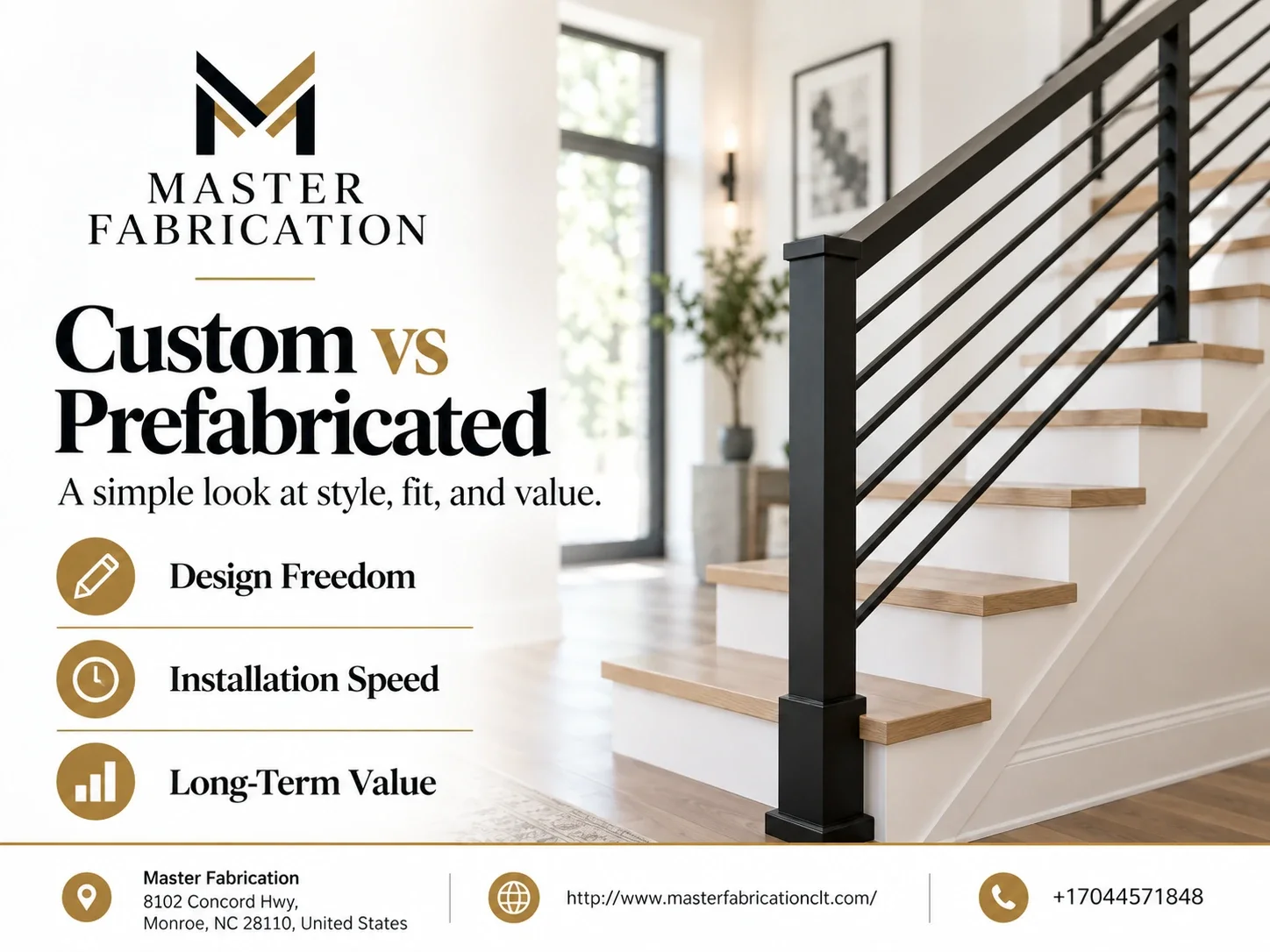
What Are the Advantages and Limitations of Custom Stair Railings?
Custom railings can be a strong choice when design flexibility and precise adaptation are priorities.
Advantages of Custom Railings
Greater design freedom
Homeowners can often have more input into patterns, dimensions, finishes, posts, and other details.
Better adaptability
Custom fabrication can accommodate unusual angles, curves, and transitions.
Architectural integration
The railing can be designed to complement specific features within the home.
More control over details
Custom projects may allow greater choice in profiles, finishes, decorative elements, and material combinations.
Limitations of Custom Railings
More planning
The design generally needs to be finalized before fabrication begins.
Potentially longer lead times
Custom fabrication and finishing may require additional preparation.
Additional project cost
Design and fabrication work can increase the investment.
More decisions
Homeowners may need to make more choices than they would with a preconfigured system.
Custom railings are often most valuable when those additional choices solve a real design or fit requirement.
What Are the Advantages and Limitations of Prefabricated Railing Systems?
Prefabricated systems can offer a more standardized approach.
Advantages of Prefabricated Railings
Simpler selection
Homeowners can choose from an established range of components and finishes.
Potentially shorter preparation time
Some stock components may be available without custom fabrication.
Predictable components
The railing is built from parts designed to work together as a system.
Potential cost efficiency
Standardized manufacturing can reduce certain design and fabrication expenses.
Limitations of Prefabricated Railings
Less design freedom
Options are generally limited to the styles and components the manufacturer provides.
Fit limitations
Unusual staircase dimensions may not align well with standard components.
Fewer custom transitions
Curves, complex landings, or unique angles may be more difficult to accommodate.
Potential adaptation requirements
Installers may need additional adjustments when standard components do not perfectly match the staircase.
A prefabricated system can be an excellent option when its design and dimensions already fit the project well.
Who Should Choose a Custom Stair Railing?
Custom railings may make sense for homeowners who prioritize:
A distinctive design
Architectural integration
Unusual staircase configurations
Custom metalwork
Specific dimensions
Curved sections
Unique transitions
Specialty finishes
One-of-a-kind details
Imagine a staircase with a sweeping curve and several custom landing transitions.
A standardized system may not accommodate those conditions easily. Custom fabrication allows the railing to be designed around the actual geometry of the staircase.
Custom may also be appealing when the railing is intended to become a major visual feature of the home rather than simply a functional element.
Who Should Consider a Prefabricated Railing System?
Prefabricated systems may work well for homeowners who have:
A relatively standard staircase
Straight railing runs
Common landing configurations
A style available within an existing product line
Fewer customization requirements
A preference for simpler product selection
For example, a homeowner with a straightforward staircase may find a prefabricated system that already provides the desired appearance and fits the required dimensions.
In that situation, custom fabrication may not provide enough additional benefit to justify the added planning.
The important thing is finding a system that meets both functional and aesthetic expectations.
How to Choose the Right Railing Approach for Your Home
Start with the staircase itself.
Before deciding whether you want custom or prefabricated components, evaluate:
Staircase shape
Railing length
Landings
Angles
Curves
Existing posts
Mounting conditions
Surrounding architecture
Then consider your priorities.
Ask yourself:
How important is customization?
If you want a specific pattern, dimension, finish, or architectural detail, custom may offer more flexibility.
How straightforward is the staircase?
Standard configurations may work well with prefabricated systems.
What is your budget?
Compare complete project estimates rather than component prices alone.
How quickly do you want to complete the project?
Prefabricated components may sometimes be available sooner, while custom fabrication can add preparation time. Actual schedules still depend on product availability and installer scheduling.
How important is long-term design integration?
If the railing needs to coordinate with other custom architectural elements, greater design control may be worthwhile.
You should also consider applicable safety and railing requirements as part of the project. A professional assessment can help determine whether a proposed system is appropriate for the staircase.
How Our Charlotte Stair Railing Team Can Help
At Master Fabrication, we help Charlotte homeowners compare railing options based on the staircase they actually have rather than assuming one approach works for every project.
Some homes are excellent candidates for systems built from standard components.
Others benefit from custom fabrication because of:
Curves
Complex transitions
Unusual dimensions
Design requirements
Architectural details
Specialty finishes
Our process begins by evaluating the existing staircase and understanding what you want the finished railing to look like.
From there, measurements and design preferences can help determine which approaches are practical.
A visit to a staircase design center can also help homeowners compare styles, materials, and railing concepts before making a final decision.
The goal is not to choose custom simply because it is custom.
It is to choose the railing approach that makes the most sense for the dimensions, appearance, function, budget, and long-term expectations of your home.
FAQs
Are custom railings always better than prefabricated railings?
No. Custom railings offer more design flexibility, but a quality prefabricated system may be an excellent fit for a straightforward staircase. The best choice depends on the project.
What is considered a custom stair railing?
A custom railing is generally designed or fabricated around the specific measurements, configuration, and aesthetic requirements of a particular staircase rather than being assembled solely from predetermined standardized components.
Are prefabricated railings lower quality?
Not necessarily. Quality depends on the materials, manufacturing, hardware, finishing, installation, and suitability of the system for the staircase.
Do custom railings fit better?
Custom fabrication can provide greater flexibility for unusual dimensions, curves, transitions, or mounting conditions. A prefabricated system can also fit very well when the staircase matches its available dimensions.
Are custom stair railings more expensive?
They can be because custom design, fabrication, finishing, and installation may require additional work. However, total project cost depends on many factors beyond whether the railing is custom.
Are prefabricated railing systems faster to install?
They may sometimes require less preparation because components are produced in advance. Actual project schedules depend on product availability, staircase conditions, finishing, and installation complexity.
Can prefabricated railings be customized?
Some systems allow homeowners to choose from different posts, balusters, finishes, hardware, or other components. The amount of flexibility depends on the manufacturer and system.
When is a custom railing worth considering?
Custom fabrication is particularly useful when a staircase has unusual dimensions, curves, multiple transitions, architectural details, or highly specific design requirements.
Can a curved staircase use prefabricated railings?
Possibly, depending on the system, but curves often create more complex measurement and fitting requirements. Custom fabrication may be more practical when standard components cannot accommodate the geometry.
Which railing option is more durable?
Neither category is automatically more durable. Material quality, hardware, finishing, installation, maintenance, and suitability for the staircase play larger roles.
How do I know whether a prefabricated system will fit my stairs?
Accurate measurements and an assessment of the staircase configuration are essential. An installer can compare those conditions with the dimensions and capabilities of the available railing system.
How can I decide between custom and prefabricated stair railings in Charlotte?
Start with a professional staircase assessment and design discussion. Comparing the actual dimensions, existing conditions, desired appearance, available products, budget, and customization requirements can help determine which approach makes more sense for your home.