
How to Make a Dark Stairwell Feel Brighter With the Right Railing
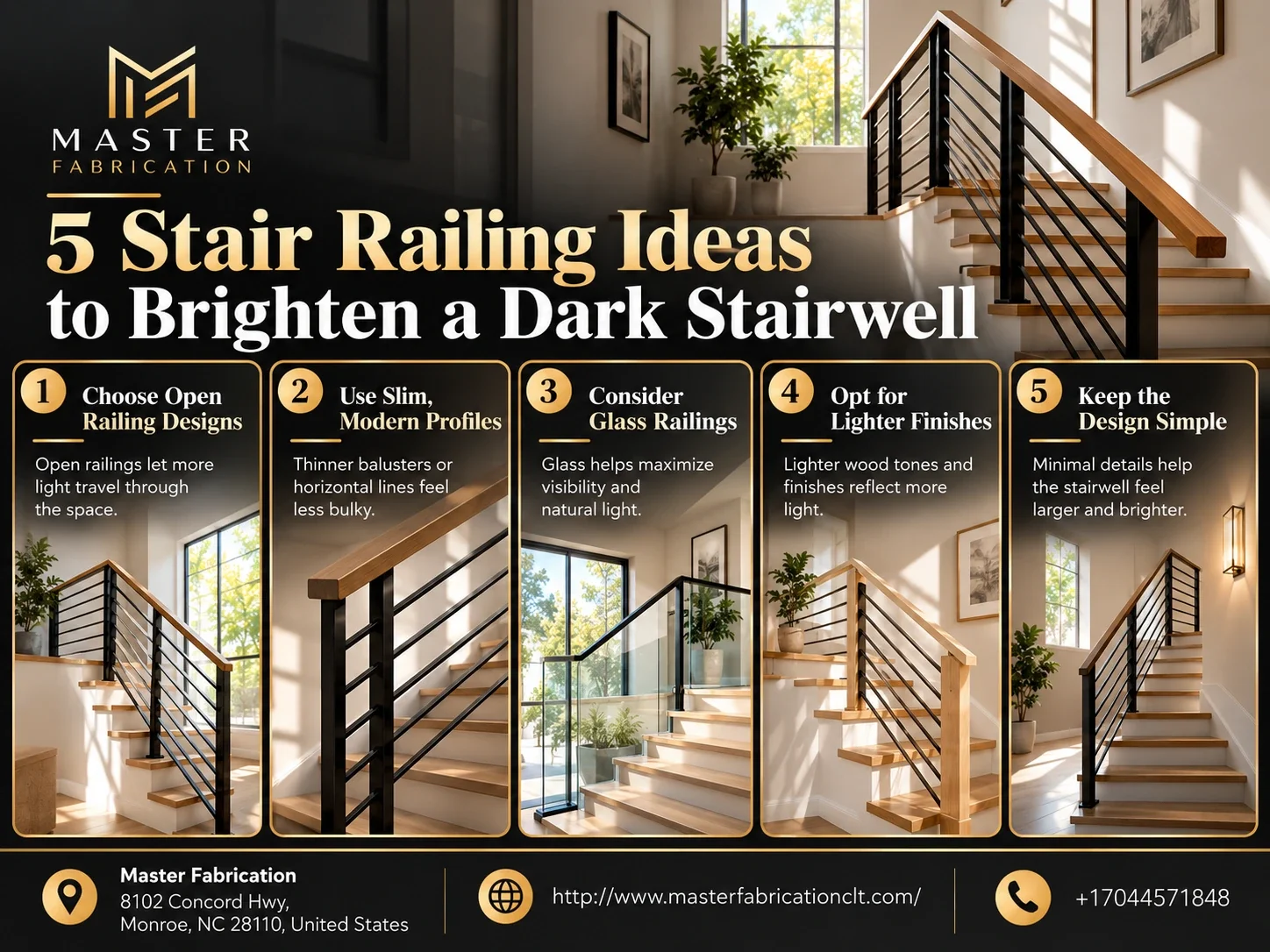
A dark stairwell can often feel brighter and more open when the railing allows light and sightlines to pass through instead of visually enclosing the staircase. Open railing systems, slim profiles, reflective finishes, thoughtful spacing, and lighter colors can all reduce visual heaviness and help existing natural or artificial light reach more of the space.
The railing itself does not create more light, but it can affect how bright a stairwell appears. At Master Fabrication, we look at railing design as part of the entire staircase environment, including wall colors, flooring, nearby windows, light fixtures, and the architectural style of the home.
Why Do Some Stairwells Feel Dark and Closed In?
Stairwells can feel unusually dark because they are often located away from exterior windows or positioned between walls that limit the movement of natural light.
The staircase itself may also contribute to the effect. Heavy railings, solid half-walls, thick wood balusters, dark finishes, and visually dense patterns can interrupt sightlines and make an already narrow space seem more enclosed.
Several design factors commonly contribute to a dark stairwell:
Limited natural light
Few or small nearby windows
Dark wall paint
Dark flooring or stair treads
Solid walls along the staircase
Wide or closely spaced railing components
Heavy decorative patterns
Dark, matte railing finishes
Insufficient artificial lighting
Some staircases have several of these conditions at the same time. For example, a staircase with dark hardwood treads, beige walls, thick wooden balusters, and no nearby window may feel considerably darker than a similar staircase with open metal railing and lighter surrounding finishes.
The goal is not necessarily to make every component white or reflective. Instead, the design should reduce unnecessary visual barriers while maintaining a railing style that makes sense for the home.
How Can an Open Railing Make a Stairwell Feel Brighter?
An open railing can improve perceived brightness by allowing the eye to see beyond the staircase rather than stopping at a solid surface.
When you replace a solid half-wall or visually heavy railing with a more open system, nearby rooms may become visible through the railing. Light from windows, fixtures, or adjoining spaces may also remain more visually apparent.
This can make the staircase feel connected to the rest of the interior instead of functioning as a dark corridor.
Choose Slimmer Railing Components
Slim posts, narrow balusters, cable runs, or streamlined metal profiles can reduce the amount of material within your field of view.
That difference can be especially noticeable in:
Narrow stairways
Interior staircases without windows
Small entryways
Split-level homes
Staircases between living spaces
Landings surrounded by walls
A railing does not need to disappear entirely. It simply needs enough openness to prevent the staircase from feeling unnecessarily enclosed.
Consider the View Through the Railing
Stand at the bottom, top, and side of your staircase and look through the existing railing.
What do you see?
If a brighter hallway, window, kitchen, living room, or entryway sits beyond the railing, preserving that visual connection can help the staircase appear more open.
A dense railing can block that view even when it technically allows some light through.
That is why railing design should be considered from several viewing angles rather than only from directly beside the stairs.
Does Cable Railing Help Preserve Light and Sightlines?
Cable railing can be particularly effective when maintaining long sightlines is a priority.
Horizontal stainless steel cables have a relatively slim visual profile, allowing the surrounding architecture to remain visible through the railing. This can help reduce the sense of enclosure in stairwells where traditional wood balusters or ornate metal patterns would feel visually heavier.
Cable railing can work especially well in contemporary, transitional, industrial, and modern interiors.
Why Cable Railing Can Feel Visually Lighter
Cable systems typically use narrow horizontal lines rather than a large number of thick vertical components.
From normal viewing distances, those cables may appear less dominant than conventional balusters.
That can allow attention to move toward:
A window at the end of the hallway
An open living room
Architectural details
Artwork
A bright wall
An upper landing
Decorative lighting
The result is often a staircase that feels more integrated with the surrounding space.
Cable Railing Still Needs Careful Design
Cable railing is not automatically the right option for every staircase.
Post dimensions, cable spacing, mounting details, code requirements, stair geometry, and the surrounding architectural style all affect the final result.
A very heavy post system combined with cable infill may still feel visually substantial.
The most successful designs balance structural requirements with clean proportions so the railing remains open without appearing unfinished.
How Can Stainless Steel Affect Light and Visual Openness?
Stainless steel can support a brighter visual environment because it often has a clean, reflective surface that interacts with surrounding light.
Unlike dark, visually heavy materials, stainless steel can catch highlights from windows, recessed fixtures, pendants, or wall sconces.
This does not mean stainless steel substantially increases the actual illumination level in a stairwell. Instead, reflected highlights can make the railing appear lighter and more visually active.
Polished Versus Brushed Stainless Steel
Different stainless steel finishes interact with light differently.
Polished stainless steel reflects more defined highlights and surrounding shapes. It can create a brighter, more reflective appearance, particularly in modern interiors.
Brushed stainless steel has a softer sheen. Rather than producing mirror-like reflections, it diffuses light across the surface.
A brushed finish can be useful when homeowners want some reflectivity without the highly polished appearance of chrome-like surfaces.
Use Stainless Steel Strategically
An entire railing does not necessarily need to be stainless steel.
It may appear in:
Cable lines
Handrails
Post caps
Mounting hardware
Decorative accents
Mixed-material railing systems
Combining stainless steel details with painted metal, glass, or wood can introduce subtle reflective surfaces without making the staircase feel overly industrial.
Which Railing Finishes Reflect the Most Light?
Railing finishes range from highly reflective to extremely matte, and that difference can change how visually bright the staircase feels.
In general, smoother finishes with some sheen interact more noticeably with light than flat, dark finishes.
Polished Metal
Polished stainless steel and similar smooth metal finishes produce the strongest reflections.
They can pick up:
Daylight from windows
Ceiling fixtures
Wall sconces
Pendant lights
Nearby bright surfaces
These reflections can help create visual movement and prevent a railing from looking like a solid dark mass.
Brushed Metal
Brushed metal provides more subdued reflections.
It can be a good compromise for homeowners who want a clean, lighter-looking railing without the high shine of polished metal.
Satin and Semi-Gloss Finishes
Painted railings with satin or semi-gloss finishes may reflect more ambient light than completely matte finishes.
The effect is subtle, but in a small staircase, even small changes in surface reflectivity can influence how open the environment feels.
Matte Finishes
Matte finishes absorb more visual attention because they create fewer highlights.
That does not mean they should be avoided.
A matte black railing, for example, can still work beautifully in a bright staircase when the profile is slim and the surrounding surfaces are light.
The overall design matters more than the finish alone.
How Does Baluster Spacing Affect the Look of a Dark Stairwell?
Baluster spacing can have a major effect on how visually dense a railing appears.
Two railings made from the same material can feel completely different depending on the thickness, spacing, orientation, and pattern of their balusters.
Thinner Profiles Feel More Open
Narrow metal balusters generally interrupt sightlines less than thick wood components.
That can help a staircase feel lighter while still providing a clearly defined railing.
Repetitive Patterns Can Create Visual Density
Closely repeated decorative elements can make a railing appear busier.
Scrollwork, baskets, twists, geometric patterns, or multiple layered components may be attractive in the right setting, but they can also create visual weight.
In a dark stairwell, simpler patterns often preserve openness more effectively.
Safety Requirements Still Control Spacing
Visual openness cannot come at the expense of railing safety.
Guard and baluster spacing must meet applicable building-code requirements.
That means the goal is not simply to make spaces between components as large as possible. Instead, railing components should be designed within required safety limits while avoiding unnecessary visual bulk.
A professional railing design should balance openness, appearance, and code compliance from the beginning.
What Railing Colors Work Best in Low-Light Spaces?
Lighter railing colors usually feel less visually dominant in a dark stairwell because they contrast less heavily against bright walls and surrounding surfaces.
However, color selection should also reflect the architecture of the home.
White and Off-White
White railings can visually blend with white walls, trim, or ceilings.
This can reduce the apparent weight of the railing and allow surrounding architectural features to become more noticeable.
White may work particularly well in:
Coastal interiors
Traditional homes
Transitional spaces
Farmhouse-inspired designs
Small stairways
Light Gray
Light gray provides a subtle alternative to white.
It can coordinate well with neutral flooring, stainless steel, concrete, and cooler interior palettes while keeping the railing relatively light.
Metallic Finishes
Stainless steel, nickel-toned finishes, and other metallic surfaces can appear lighter because of their reflective properties.
They are particularly effective in modern or contemporary homes.
Can Black Railing Work in a Dark Stairwell?
Yes.
Black railing can still create an open appearance when its components are narrow and the surrounding environment provides sufficient contrast.
For example, slim black metal balusters against white walls may form crisp lines without visually closing the staircase.
The problem usually comes from combining several dark, heavy features at once.
Black railing paired with dark walls, dark floors, thick posts, and limited lighting may make the staircase feel more enclosed.
Balance is more important than choosing one specific color.
How to Coordinate Stair Railings With Wall and Floor Colors
A railing should not be selected in isolation.
Walls, flooring, trim, stair treads, risers, and nearby furniture all affect how the railing appears.
Start With the Largest Surfaces
Walls and flooring usually occupy much more visual space than the railing.
If both are dark, introducing a lighter or more reflective railing can help break up the visual weight.
If the walls are already bright, a darker railing may provide useful contrast without making the space feel closed.
Consider Stair Treads and Risers Separately
Dark wood treads paired with white risers can create a balanced staircase.
A railing can then pull from either element.
For example:
Black metal railing can echo dark treads.
Stainless steel can introduce a lighter modern accent.
White posts can coordinate with risers and trim.
Wood handrails can tie into the tread color.
This creates intentional coordination instead of making every staircase component identical.
Avoid Too Many Competing Finishes
Using several metals, wood tones, paint colors, and decorative patterns within one stairwell can make a small space appear visually busy.
Limiting the palette can make the staircase feel calmer and more open.
A simple combination such as painted metal with one wood tone is often enough.
How Lighting and Railing Design Can Work Together
Railing design becomes more effective when it is coordinated with the staircase lighting plan.
Instead of treating the railing and lighting as separate projects, consider how light will interact with railing posts, cables, balusters, walls, and stair surfaces.
Wall Sconces
Wall sconces can provide vertical illumination while also creating decorative highlights.
Open railing allows these lights to remain visible from more angles.
A solid stair wall may block some of that visual connection.
Recessed Ceiling Lighting
Recessed fixtures can provide consistent illumination without adding visual clutter.
Reflective metal railing components may catch small highlights from overhead fixtures, helping define the railing after dark.
Step Lighting
Lights installed along stair walls or near individual treads can make the staircase easier to navigate while emphasizing the stair geometry.
The combination of subtle step lighting and a streamlined railing can create a clean, contemporary appearance.
Pendant Lighting
For staircases with tall ceilings or open landings, pendant lighting can become a major design feature.
An open railing helps preserve views toward the fixture from multiple floors or rooms.
A visually heavy railing may compete with the pendant or block portions of it from certain angles.
Use Light-Colored Surfaces to Support the Lighting Plan
Artificial lighting is more effective visually when surrounding surfaces are capable of reflecting some of that light.
Light walls, pale trim, reflective metal, and lighter flooring elements can all contribute to the perceived brightness of the stairwell.
What Railing Design Mistakes Can Make a Stairwell Feel Darker?
A railing can unintentionally make a dark staircase feel even more enclosed when too much visual material is concentrated within a small area.
Using Oversized Posts
Large posts can dominate narrow staircases.
They may be structurally appropriate in some designs, but unnecessary bulk can block sightlines.
Choosing proportions appropriate for the size of the staircase helps preserve openness.
Adding Too Much Decorative Detail
Highly decorative ironwork can be beautiful, particularly in large stair halls.
In a small or dim staircase, however, complex patterns may create visual clutter.
Simpler patterns can allow light and surrounding architecture to remain more noticeable.
Making Every Surface Dark
Dark railings can work well.
Dark stair treads can also work well.
Dark walls can create dramatic interiors.
Combining all three in an already low-light stairwell, however, may make the area feel considerably heavier.
Introducing contrast can help.
Ignoring Adjacent Rooms
A railing might appear attractive when viewed directly but block an important sightline toward a brighter nearby room.
The design should be evaluated from the hallway, entryway, landing, living space, and staircase itself.
Choosing Style Without Considering Scale
A railing style that works in a large foyer may feel oversized in a narrow stairwell.
Post dimensions, handrail size, baluster pattern, and decorative elements should be scaled appropriately for the surrounding space.
Expecting the Railing to Solve a Lighting Problem by Itself
Changing the railing can improve perceived openness, but it cannot compensate for inadequate lighting.
A staircase that is genuinely too dark may also need changes such as:
Additional fixtures
Higher-output bulbs
Better fixture placement
Lighter wall colors
Improved daylight access
More reflective finishes
The best results usually come from looking at the staircase as a complete environment.
Designing a Brighter-Looking Staircase With Master Fabrication
A railing can change how open, connected, and visually bright a staircase feels without requiring the railing to become the focal point of the room.
At Master Fabrication, we help homeowners evaluate the entire stair environment before choosing a railing design. That includes the amount of available light, nearby sightlines, staircase dimensions, wall and floor finishes, railing proportions, and the architectural character of the home.
Depending on the space, a streamlined metal railing, cable system, stainless steel details, simplified baluster pattern, or mixed-material design may help reduce visual heaviness while complementing the rest of the interior.
The goal is not simply to choose the lightest color or the thinnest component. A successful staircase should feel intentional from every angle while meeting the structural and safety requirements of the project.
If your existing staircase feels dark, heavy, or visually closed in, the railing may be one of several elements worth reconsidering. Our team at Master Fabrication can help develop a railing design that supports better sightlines, appropriate proportions, and a more open overall look.
FAQs
Can changing a railing really make a stairwell look brighter?
Yes. A more open railing can preserve sightlines and reduce visual barriers, which may make the staircase feel brighter and less enclosed. It does not increase the actual amount of light by itself.
What is the best railing style for a dark staircase?
Open designs with slim components are often effective. Cable railing, streamlined metal balusters, and simple mixed-material systems can preserve views better than visually dense railing designs.
Is stainless steel good for a low-light stairwell?
Stainless steel can work well because its surface reflects highlights from windows and artificial lighting. Brushed stainless provides subtle reflectivity, while polished finishes create stronger reflections.
Should I avoid black railing in a dark stairwell?
Not necessarily. Slim black railing can provide attractive contrast against light walls. The staircase is more likely to feel dark when several heavy or dark elements are combined without enough visual contrast or lighting.
Do horizontal cable railings make a staircase feel more open?
They can. Their narrow horizontal lines generally preserve long sightlines better than many thicker railing systems. The effect depends on the posts, cable spacing, staircase layout, and surrounding finishes.
Should I change the lighting when installing a new railing?
It is worth considering. Coordinating railing design with sconces, recessed lighting, step lights, or pendant fixtures can create a more cohesive result and improve how the staircase looks after dark.