
How to Match Stair Railings With Hardwood Floors
Matching stair railings with hardwood floors is less about finding an exact color match and more about creating a balanced relationship between the materials. The best combinations usually coordinate undertones, contrast, finish, and overall interior style so the staircase feels intentional instead of added later.
A railing can closely match the flooring, provide a darker or lighter contrast, or introduce metal to break up large areas of wood. The right approach depends on the floor color, surrounding trim, cabinetry, wall colors, and how much you want the staircase to stand out.
Should Stair Railings Match Hardwood Floors?
Not necessarily.
A stair railing does not need to be the exact same color as the hardwood floor to look cohesive. In fact, trying to match two wood finishes perfectly can sometimes make slight differences more noticeable.
Instead, aim for coordination.
The railing and flooring should relate through one or more of the following:
Similar undertones
Complementary stain colors
Repeated wood species
Consistent finish sheen
Coordinating metal accents
Intentional contrast
For example, medium oak flooring may work well with a slightly darker oak handrail rather than an identical stain.
Likewise, light hardwood can pair beautifully with matte black metal railing when the goal is a more modern or transitional look.
Think of the railing as part of the entire room rather than an extension of the floor alone.
How to Identify the Undertones in Hardwood Flooring
Before choosing a railing stain or material, look closely at the undertone of the flooring.
Most hardwood floors lean toward one of several general color families.
Warm Undertones
Warm floors may include hints of:
Red
Orange
Honey
Gold
Caramel
Traditional red oak, cherry, and many medium brown stains often fall into this category.
Cool Undertones
Cooler hardwood may contain:
Gray
Taupe
Ash
Muted brown
Slight blue or green influence
These floors are common in contemporary and modern interiors.
Neutral Undertones
Neutral flooring sits somewhere between warm and cool.
Natural white oak is a common example because it can work with both warmer and cooler palettes depending on the finish.
The easiest way to identify an undertone is to compare the flooring with nearby materials.
Place stain samples, paint swatches, cabinetry, or wood pieces directly beside the floor.
A finish that looks neutral on its own may suddenly appear very orange or gray when placed next to the existing flooring.
This is why choosing railing stains from a small sample card without comparing them in the actual room can lead to disappointing results.
Should You Match or Contrast Your Stair Railing?
Both approaches can work.
The choice depends on whether you want the railing to blend into the room or become a stronger architectural feature.
Matching or Closely Coordinating
A coordinated railing creates a quieter, more unified appearance.
This approach works well when:
The flooring is already a major design feature
The room has several other materials and colors
The home has a traditional style
You want the staircase to feel integrated
For example, medium oak floors with a slightly deeper oak handrail can look cohesive without appearing overly matched.
Creating Contrast
Contrast gives the staircase more definition.
A darker railing against light floors can frame the staircase and draw attention to its shape.
Common examples include:
Light oak floors with black metal railing
Natural wood floors with dark walnut handrails
Medium brown floors with painted white newel posts
Dark hardwood floors with lighter wood accents
Contrast works particularly well in contemporary and transitional interiors.
The main goal is making sure the contrast looks intentional rather than accidental.
How to Coordinate Wood Handrails With Hardwood Floors
Wood handrails do not need to use the exact same species or stain as the flooring, but they should generally work within the same color family.
Several approaches can work.
Use the Same Wood Species
Using the same species can create visual consistency even when the stains vary slightly.
For example:
White oak flooring + white oak handrail
Red oak flooring + red oak handrail
Walnut flooring + walnut rail
This approach makes grain patterns feel connected.
Use a Slightly Darker Stain
A handrail that is one or two shades darker than the floor can provide definition without creating a sharp contrast.
This is especially effective when the staircase needs to stand out subtly.
Match the Stair Treads Instead
If the stair treads already match the flooring, coordinating the handrail with the treads can create a natural visual connection.
Coordinate Undertones Rather Than Exact Color
A medium brown floor and darker brown handrail can work well if both share warm undertones.
Problems often appear when one wood is very orange and the other has a noticeably gray or cool base.
How to Pair Metal Railings With Wood Flooring
Metal railings are one of the easiest ways to complement hardwood floors without worrying about perfect stain matching.
They introduce contrast and break up large areas of wood.
Black Metal
Matte or satin black pairs well with:
Light oak
Medium oak
Walnut
Gray-toned hardwood
Natural wood flooring
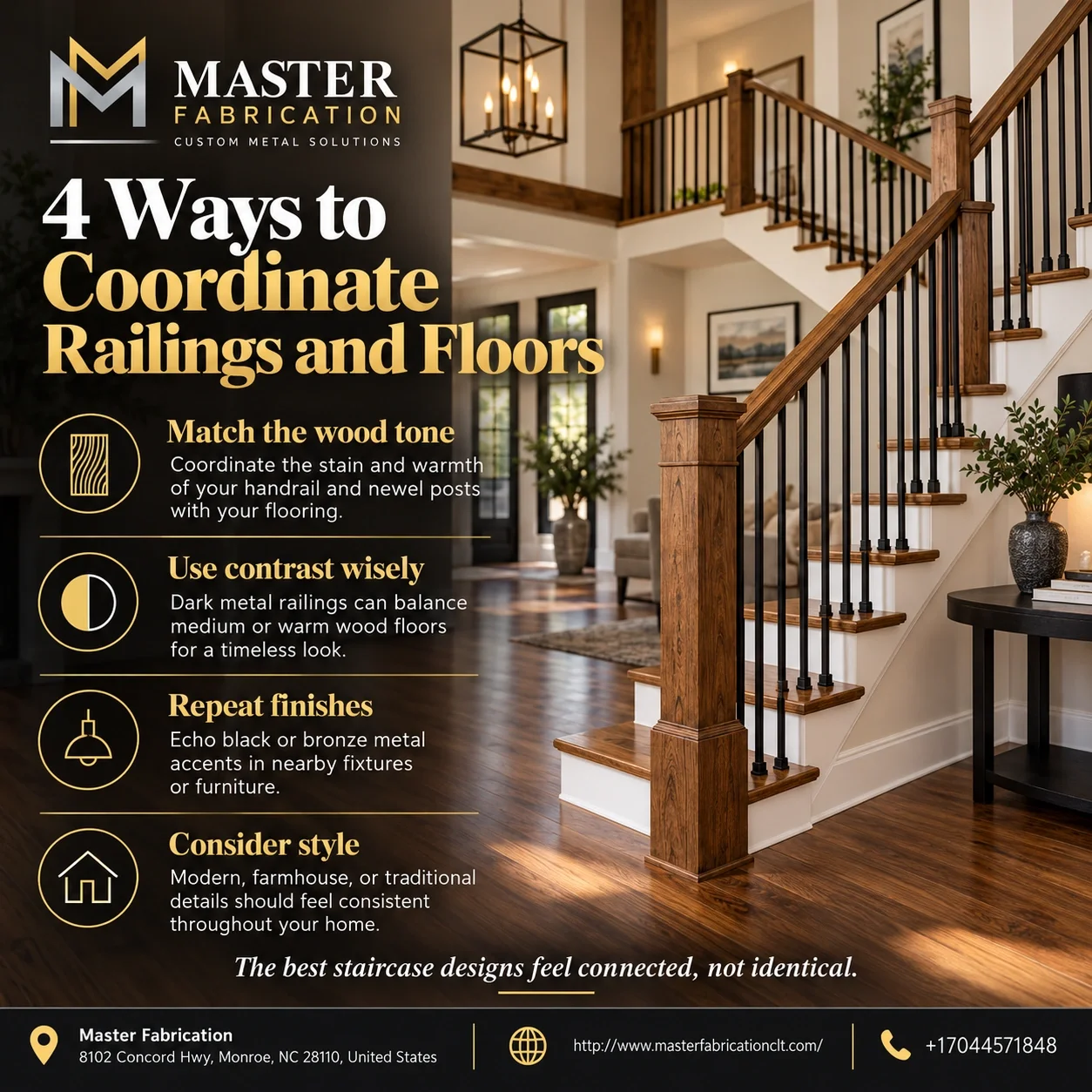
Black railing creates a crisp visual outline and often works in modern, industrial, transitional, and updated traditional interiors.
Bronze or Dark Brown Metal
Warmer metal finishes can complement honey, red, or amber-toned hardwood.
These finishes tend to feel softer and more traditional than black.
Brushed or Stainless Metal
Cooler metallic finishes can work with contemporary interiors and gray-toned flooring.
However, they often create a stronger modern statement.
Wood and Metal Combinations
One of the most flexible approaches is to combine a wood handrail with metal balusters.
This allows the railing to connect directly with the flooring while still adding contrast.
For example:
Light oak floor + oak handrail + black iron balusters
Dark walnut floor + walnut handrail + simple black metal
Medium oak floor + stained wood newels + matte black balusters
This mixed-material approach can bridge traditional and modern design very effectively.
How to Choose the Right Wood Stain and Finish
Stain color is only one part of the decision.
Finish sheen also affects how closely two wood surfaces appear to match.
A glossy handrail can look much darker and richer than a matte floor even if both use similar stain colors.
Common finish options include:
Matte
Satin
Semi-gloss
Gloss
Most modern hardwood floors use lower-sheen finishes, so satin or matte railing finishes often feel more cohesive.
When comparing stains:
Test several options on the actual wood species.
View them next to the flooring.
Check them in both daylight and artificial light.
Look at them from several angles.
Compare them with nearby trim and cabinetry.
Wood species can react differently to the same stain.
A stain that looks medium brown on oak may appear much darker or more uniform on maple.
Always test the stain on the actual material when possible.
How Other Woodwork in the Home Affects Your Railing Choice
The staircase does not exist in isolation.
Nearby woodwork can influence whether the railing feels cohesive.
Consider:
Kitchen cabinetry
Interior doors
Baseboards
Crown molding
Fireplace mantels
Ceiling beams
Furniture
Built-in shelving
Window trim
If the home already contains several wood tones, adding another strong stain may create too much visual competition.
In that situation, a painted or metal railing may simplify the palette.
On the other hand, if the interior has relatively few wood elements, matching the handrail to the floor can strengthen continuity.
You do not need every wood surface to match.
Well-designed interiors often include several different wood tones.
The important thing is that those tones share compatible undertones and appear intentionally layered.
Common Railing and Hardwood Floor Matching Mistakes
A few mistakes can make an otherwise attractive staircase feel disconnected.
Trying to Match Too Exactly
Two wood finishes that are almost the same but not quite can look less intentional than a clearly coordinated contrast.
Ignoring Undertones
A gray-brown railing beside orange-toned hardwood can clash even if both are technically medium brown.
Introducing Too Many Wood Colors
Flooring, stair treads, handrails, newels, and cabinetry all in different stains can make the room feel fragmented.
Forgetting About Metal Finishes
Black balusters, brass lighting, chrome hardware, and bronze fixtures may compete if there is no overall finish strategy.
Choosing From Small Samples
A two-inch stain chip can look very different when applied across a long handrail or large newel post.
Ignoring Natural Light
Sunlight can make wood appear warmer, while cooler artificial lighting may bring out gray undertones.
Treating the Staircase Separately From the Room
The best railing usually connects with multiple elements in the space rather than only the flooring.
Popular Hardwood Floor and Railing Combinations
A few pairings work across a wide range of interiors.
Natural White Oak + Matte Black Railing
This is a clean, modern combination with strong contrast.
The warm, light floor keeps the room inviting while black metal adds definition.
Medium Oak + Dark-Stained Wood Handrail
A classic choice for traditional or transitional homes.
The handrail feels related to the flooring but stands out enough to define the staircase.
Dark Walnut + Simple Black Iron
Rich dark flooring combined with black iron creates a sophisticated look.
Keeping the baluster design simple prevents the space from feeling overly heavy.
Light Oak + White Newels + Black Iron Balusters
This combination works especially well in transitional interiors.
White posts relate to the trim, black iron adds contrast, and wood treads or rails connect back to the floor.
Gray-Toned Wood + Black Steel
Cool flooring paired with black metal produces a contemporary, understated look.
Warm Honey Oak + Bronze Metal
Bronze or dark brown metal can soften the contrast and work well with more traditional warm-toned flooring.
How to Create a Cohesive Staircase Design
Start by identifying the dominant finishes already in the room.
Then decide which parts of the staircase should blend and which should provide contrast.
A balanced design might follow a simple structure:
Floors and stair treads share a similar wood tone
The handrail is slightly darker
Newel posts coordinate with trim
Metal balusters introduce contrast
Another room might use:
Light floors
Matching light wood handrail
Black newel posts
Black metal balusters
Both can work because the relationships are clear.
Keep the number of finishes controlled.
Three coordinated materials usually feel more intentional than six unrelated ones.
It also helps to view the staircase from nearby spaces.
Consider how it looks from:
The entryway
Living room
Kitchen
Upper landing
Hallway
At Master Fabrication, we help homeowners choose railing materials and finishes that work with the entire interior rather than forcing an exact match to one surface. Hardwood flooring, stair treads, trim, metal finishes, and architectural style all influence the final result.
A custom railing can either blend quietly into the home or become a focal point. The key is making sure the relationship between the railing and flooring looks deliberate from every angle.
FAQs
Does a stair railing need to match hardwood floors exactly?
No. Exact matching is not necessary. Coordinating undertones, wood species, or overall color families often creates a more natural appearance than trying to duplicate the floor perfectly.
Should a handrail be darker than the floor?
It can be. A slightly darker handrail often gives the staircase more definition while still coordinating with the flooring. The difference should look intentional rather than like a failed match.
What railing color looks best with light hardwood floors?
Black metal, natural wood, white-painted components, and darker wood handrails can all work with light flooring. The best option depends on the home's architectural style and other finishes.
Can you mix different wood species on stairs and floors?
Yes. Different wood species can work together when the undertones and finishes coordinate. Compare actual samples because grain patterns and stain absorption can vary significantly between species.
Does black railing go with brown hardwood floors?
Yes. Black railing is highly versatile and pairs well with many brown hardwood tones. It creates clear contrast while allowing the wood flooring to remain a major visual element.
Should stair treads match the hardwood floor?
They often do, but they do not have to match exactly. Many homeowners coordinate the treads closely with the floor while using the handrail, newels, or balusters to introduce contrast.