
How to Mix Wood, Iron, and Stainless Steel in One Staircase
You can mix wood, iron, and stainless steel in one staircase successfully when each material has a clear purpose. The strongest designs usually make one material dominant, use a second for structure or contrast, and reserve the third for smaller accents rather than giving all three equal visual weight.
Wood brings warmth and texture, iron adds definition and architectural character, and stainless steel introduces a cleaner, more reflective detail. At Master Fabrication, we look at how these materials relate to the staircase, flooring, surrounding rooms, and existing finishes before deciding where each one belongs. The goal is a staircase that feels coordinated rather than assembled from unrelated parts.
Can Wood, Iron, and Stainless Steel Work Together in One Staircase?
Yes. Wood, iron, and stainless steel can complement one another because each material contributes something different.
Wood usually feels warm and residential. Iron tends to provide stronger visual definition, particularly when finished in black or another dark tone. Stainless steel feels cleaner and more contemporary because of its smooth surface and subtle reflectivity.
The challenge is not whether the materials can work together. It is controlling how much of each material is visible.
A staircase may become visually confusing when:
Wood appears in several unrelated tones
Black iron is used for every structural component
Stainless steel is added to too many small details
Several different metal finishes compete with one another
Each material is treated as a separate focal point
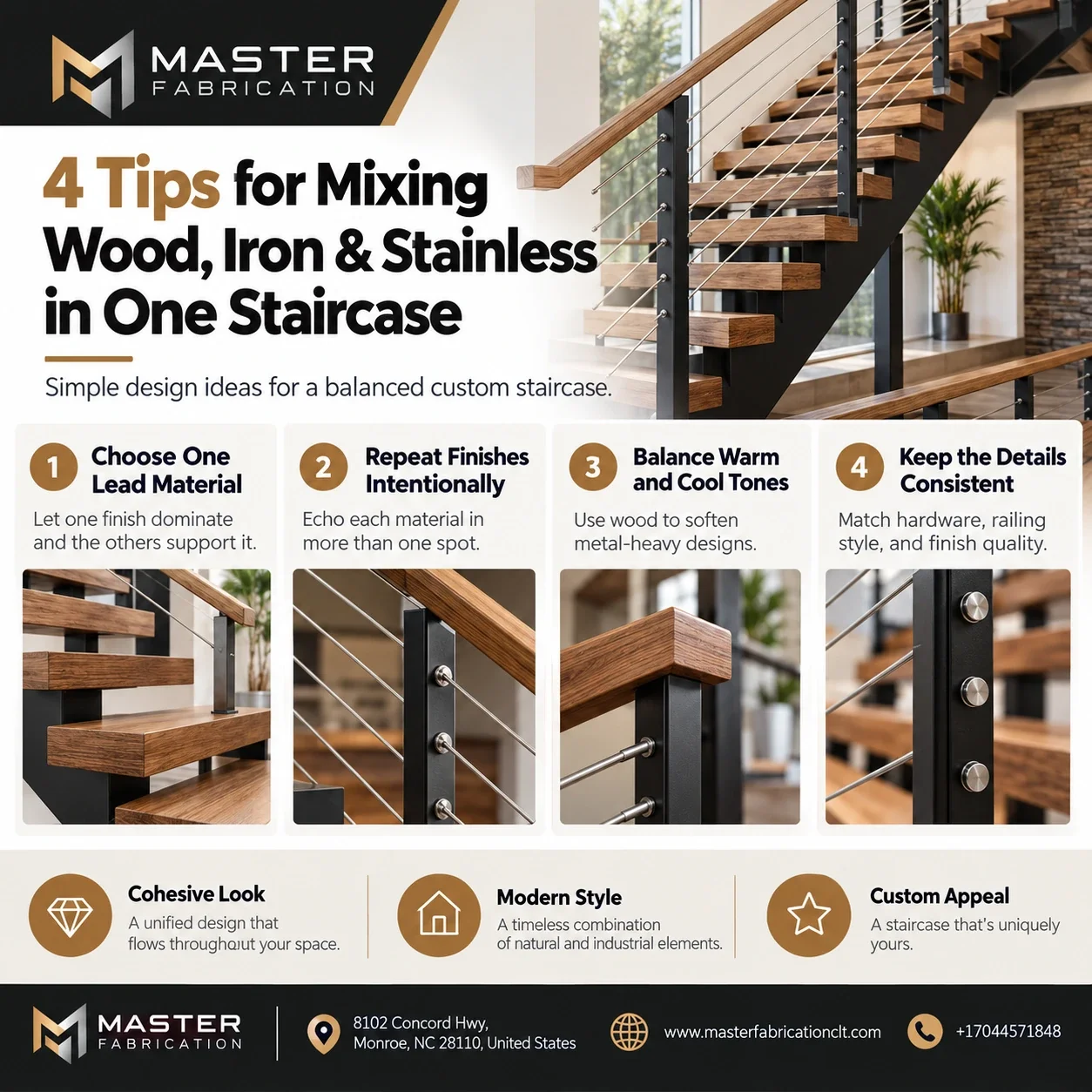
A more cohesive approach might use wood for the treads and handrail, iron for posts or balusters, and stainless steel only for cable, brackets, or hardware.
This creates a visual hierarchy.
Instead of noticing three separate materials, you see one staircase with carefully layered details.
Start With the Architecture
Mixed materials should make sense within the home.
A contemporary staircase may support more stainless steel, while a transitional home may benefit from wood and iron with only small stainless accents.
The surrounding architecture can help determine the balance.
Look at:
Flooring
Doors
Cabinetry
Furniture
Light fixtures
Window frames
Hardware
Existing metal finishes
If the home already has black metal throughout, iron can provide continuity. If brushed stainless appears in the kitchen or lighting, stainless railing details may feel more connected.
Wood can then bridge these harder materials and keep the staircase feeling comfortable.
How to Assign Each Material a Clear Design Role
One of the simplest ways to make three materials work together is to decide what each one is responsible for.
A useful approach is to separate the materials into three roles:
Dominant material
Supporting material
Accent material
This prevents competition.
Use Wood for Warmth
Wood is often a natural choice for:
Handrails
Stair treads
Newel caps
Posts
Decorative trim
Because people physically touch the handrail and see the stair treads repeatedly, wood can make an otherwise metal-heavy staircase feel warmer.
Use Iron for Structure and Definition
Iron can create a strong visual framework.
It may be used for:
Balusters
Newel posts
Decorative panels
Structural railing components
Geometric details
Dark iron is especially effective when homeowners want clear lines and contrast.
Use Stainless Steel for Precision
Stainless steel works well for details that benefit from a refined or contemporary appearance.
Common uses include:
Cable infill
Mounting brackets
Fasteners
Post caps
Connectors
Decorative accents
Using stainless steel selectively allows its finish to stand out without making the staircase feel overly industrial.
Avoid Giving Everything Equal Weight
Imagine a staircase with dark wood treads, large black iron panels, stainless posts, a stainless handrail, wood newels, and visible polished hardware.
Each component may look attractive individually, but together they can compete.
A more controlled version might use:
Wood treads and handrail
Black iron posts
Stainless steel cable
That gives every material a clear job.
Which Material Should Be the Visual Focus?
Usually, one material should establish the staircase's overall identity.
The other materials should support it.
Which material takes the lead depends on the home and the desired style.
When Wood Should Lead
Let wood dominate when the goal is warmth, comfort, or continuity with hardwood flooring and furniture.
A wood-led staircase might include:
Wood treads
Wood handrail
Black iron posts
Stainless steel cable
The viewer notices the wood first, while the metal provides structure and detail.
This can work particularly well in transitional or warm contemporary interiors.
When Iron Should Lead
Iron can become the main visual element when the staircase is intended to feel architectural.
For example:
Black iron posts
Repeating iron balusters
A warm wood handrail
Small stainless steel hardware details
This creates stronger contrast and gives the staircase more definition.
When Stainless Steel Should Lead
Stainless steel can take the primary role in a modern or highly contemporary space.
A design might use:
Stainless steel posts
Stainless cable
Warm wood handrail
Limited dark iron details
Because stainless steel has a visually distinctive finish, the iron should usually remain restrained if stainless is already dominant.
Consider What You See From Across the Room
The dominant material should make sense from a distance.
Small stainless connectors may be noticeable up close but disappear across a large room.
Iron posts or a wood handrail will usually establish the overall silhouette more clearly.
This is why the design should be reviewed both close up and from surrounding rooms.
How to Coordinate Wood and Metal Finishes
Mixing materials does not require everything to match.
In fact, trying to match every finish exactly can make the design feel forced.
The goal is compatibility.
Pay Attention to Undertones
Wood can have:
Golden undertones
Red undertones
Neutral brown tones
Gray undertones
Dark espresso tones
Metal finishes also have visual temperatures.
Black iron is relatively neutral. Brushed stainless usually feels cooler. Bronze-inspired finishes tend to feel warmer.
A warm oak handrail can create an attractive contrast with brushed stainless because the materials are clearly different.
Problems often arise when two finishes are almost, but not quite, the same.
Coordinate With Nearby Fixtures
Look beyond the staircase.
If the home uses brushed stainless cabinet hardware, stainless railing details may feel intentional.
If nearby doors and windows have black frames, black iron may connect naturally with those features.
Wood can coordinate with flooring, cabinetry, or furniture.
This creates continuity without requiring every finish to repeat exactly.
Choose One Consistent Metal Finish Per Material
Avoid mixing polished stainless, brushed stainless, glossy black iron, matte black iron, and additional metallic finishes unless there is a clear design reason.
Consistency helps simplify the overall palette.
For example:
Matte black iron
Brushed stainless steel
Natural oak
That combination is easier to understand visually than several competing finish types.
How to Balance Warm Wood With Cool Stainless Steel
Wood and stainless steel create a natural contrast.
Wood tends to bring warmth and variation. Stainless steel is more precise and uniform.
The key is allowing that difference to become part of the design.
Let Wood Occupy Larger Touchpoints
A wood handrail is one of the most effective ways to soften stainless steel.
The handrail is visually prominent and physically used every day.
Wood treads can reinforce the effect.
This allows stainless steel to provide clean detail without making the staircase feel cold.
Use Brushed Stainless for a Softer Look
Highly polished stainless steel produces stronger reflections and can feel more visually dramatic.
Brushed stainless steel has a quieter appearance.
Its softer sheen often pairs easily with wood because it does not compete as strongly with the natural grain.
Allow Some Contrast
Do not try to make stainless steel feel like wood.
The contrast is part of the appeal.
A light oak handrail above stainless cable, for example, combines warmth and precision without requiring either material to imitate the other.
Consider Surrounding Lighting
Stainless steel interacts noticeably with light.
Natural daylight, pendant lighting, and wall sconces can create subtle highlights on stainless components.
Warm interior lighting can soften the overall effect, especially when the staircase also includes wood.
Where Does Iron Fit Into a Mixed-Material Staircase?
Iron can act as the visual bridge between warm wood and cooler stainless steel.
Its darker, more solid appearance adds definition.
Iron Can Create the Framework
One effective approach is to use iron for the main structural rhythm.
For example:
Black iron posts
Stainless steel cable
Wood handrail
The posts define the staircase while the cable remains visually light and the wood softens the top of the railing.
Iron Can Be Decorative
Iron can also be reserved for limited decorative elements.
A mostly stainless-and-wood staircase might include:
Iron accent panels
Iron newels
Occasional geometric inserts
This adds character without covering the railing in ornament.
Keep Decorative Iron Restrained
If stainless steel is already present, highly ornate ironwork can make the railing feel visually complicated.
Simpler iron shapes generally combine more easily with stainless.
Consider:
Straight bars
Rectangular profiles
Simple geometric panels
Minimal curves
Restrained accent balusters
Complex scrollwork can still work, but it usually needs more careful coordination with the rest of the design.
How to Keep Three Materials From Looking Too Busy
The easiest way to prevent visual clutter is to simplify everything except the material combination itself.
Three materials already provide variety.
The railing does not necessarily need multiple patterns and decorative features as well.
Use the 60-30-10 Idea as a Visual Guide
You do not need to follow exact percentages, but the concept can be useful.
One material should clearly dominate.
A second material can provide meaningful support.
The third should appear more selectively.
For example:
Wood as the dominant material
Iron as the secondary structure
Stainless steel as the accent
Or:
Iron as the dominant framework
Wood as the supporting warm element
Stainless as a smaller detail
This creates hierarchy.
Limit Decorative Patterns
If the material palette is complex, keep the railing pattern simple.
Straight balusters or cable lines usually combine more comfortably with three materials than elaborate patterns.
Repeat Materials Consistently
If stainless steel appears as cable on one stair section, continuing that treatment onto a related upper-level railing creates continuity.
Suddenly switching to a different infill material can make the design feel fragmented.
Keep Connection Details Clean
Mixed-material railings often involve more visible connections.
Brackets, fasteners, cable terminals, and transitions between wood and metal should look deliberate.
Clean detailing becomes especially important in minimalist or contemporary interiors.
What Compatibility and Installation Issues Should Be Considered?
Mixed-material railings are not only a design exercise.
Wood, iron, and stainless steel behave differently and need to be joined appropriately.
Wood Moves With Environmental Conditions
Wood naturally expands and contracts as environmental conditions change.
Connections between wood and metal need to account for that movement where appropriate.
Improper connections can contribute to gaps, stress, or finish problems over time.
Metal Components Require Proper Fastening
Posts, brackets, and railing connections must be designed for the actual loads placed on the railing.
A visually minimal connection still needs sufficient structural support.
Hardware should be selected based on:
Component material
Location
Connection method
Structural requirements
Exposure conditions
Different Metals Need Thoughtful Compatibility
When different metals touch one another, environmental conditions can affect how they interact.
Material compatibility, fasteners, coatings, and separation methods should therefore be considered during fabrication and installation, particularly where moisture may be present.
This becomes especially important in exterior or high-moisture applications.
Finishes Need Protection During Installation
Wood stains, painted iron, and finished stainless steel can all be damaged if installation is handled carelessly.
Scratches in painted metal, marks on stainless steel, or damage to a finished handrail can become much more noticeable once the staircase is complete.
Planning installation order can help protect finished surfaces.
Code Still Comes First
Mixed materials do not change the basic safety responsibilities of a railing.
Guard height, handrail requirements, structural performance, openings, spacing, and other applicable requirements must still be addressed.
Design choices should work within those constraints.
How Maintenance Differs Between Wood, Iron, and Stainless Steel
Each material ages differently, so mixed-material staircases should be maintained according to the needs of each surface.
Wood
Wood handrails and treads may need periodic cleaning and eventual refinishing depending on the finish and level of use.
Common concerns include:
Scratches
Wear
Moisture exposure
Changes in finish appearance
Small dents
Harsh cleaners should generally be avoided unless they are appropriate for the specific wood finish.
Iron
Painted or coated iron should be checked periodically for damage to the finish.
Interior iron usually requires relatively straightforward cleaning, but chips or scratches in protective coatings may need attention.
Exterior iron requires more attention because moisture exposure can increase the importance of maintaining the protective finish.
Stainless Steel
Stainless steel is generally easy to clean, but it can show:
Fingerprints
Smudges
Dust
Water marks
Brushed stainless should usually be cleaned in the direction of the grain.
Highly polished stainless may show fingerprints more easily because of its reflective surface.
Choose Maintenance Expectations Early
A staircase should fit the way the household actually lives.
If homeowners do not want to regularly clean fingerprints from reflective surfaces, polished stainless might not be the best choice for a frequently touched handrail.
Using stainless steel in cable or smaller accents while keeping the handrail wood may be more practical.
Mixed-Material Staircase Combinations That Work Well
There is no single correct combination.
The strongest layouts usually give each material a specific purpose.
1. Wood Handrail + Iron Posts + Stainless Cable
This is one of the most balanced mixed-material options.
The wood provides warmth.
The iron posts create definition.
The stainless cable keeps the railing open and visually light.
It can work well in transitional, modern, and contemporary interiors.
2. Wood Treads + Iron Balusters + Stainless Accents
This arrangement feels more traditional than a full cable system while still incorporating a contemporary detail.
Stainless steel might appear in:
Post caps
Hardware
Connectors
Small decorative elements
Because the stainless is limited, the staircase still feels primarily warm and architectural.
3. Stainless Posts + Cable + Wood Handrail + Iron Newels
This combination can work well when a modern staircase needs stronger visual anchors.
The stainless posts and cable create a clean field.
Wood softens the handrail.
Dark iron newels can provide definition at the bottom, top, or landings.
4. Black Iron Frame + Wood Rail + Stainless Details
A black iron frame can establish the staircase's main identity.
Wood can then provide warmth at the handrail or newel cap.
Stainless details should remain restrained so the railing does not become overly complicated.
This works well when nearby architecture already includes black metal.
5. Wood-Dominant Staircase With Small Metal Contrasts
Homeowners who prefer a warmer interior can keep most of the staircase wood while introducing:
Black iron balusters
Stainless connectors
Stainless cable in selected sections
This creates a layered look without losing the warmth of a primarily wood staircase.
6. Iron-Dominant Staircase With Wood and Stainless Accents
For a more architectural result, iron can form the majority of the railing.
A wood handrail can soften the design while limited stainless details introduce a contemporary touch.
This combination is particularly useful when the home already includes dark steel windows, black hardware, or other strong metal features.
Create Hierarchy Before Choosing Individual Parts
Mixing wood, iron, and stainless steel successfully is less about finding three attractive materials and more about deciding how they should relate to one another.
Start with the dominant material. Then choose a supporting material that adds either warmth, structure, or contrast. Use the third material selectively where it improves the design rather than simply adding another finish.
At Master Fabrication, we look at the entire staircase before deciding how those materials should be divided. The stair shape, treads, flooring, upper-level railing, nearby furniture, lighting, existing hardware, and architectural style all influence the right balance.
A warm wood handrail over stainless cable may be enough to soften a contemporary staircase. Another home may need black iron posts to provide stronger visual structure. In some cases, stainless steel works best as a small accent rather than a major component.
The goal is a mixed-material staircase that reads as one complete design. When the roles, finishes, proportions, and connections are planned together, wood, iron, and stainless steel can create a staircase that feels layered, balanced, and intentional rather than busy.
FAQs
Can you mix black iron and stainless steel in the same railing?
Yes. Black iron can provide strong visual definition while stainless steel introduces a lighter, more contemporary detail. Keeping one finish dominant usually creates the most cohesive result.
Does a wood handrail work with stainless steel cable?
Yes. Wood can soften the cooler appearance of stainless steel and add warmth while the cable keeps sightlines open.
Should all the metals on a staircase match?
Not necessarily. Different metals can work together when their roles are clearly defined. Avoid adding several unrelated finishes without a design reason.
What wood tones work best with stainless steel?
Light oak, medium natural woods, and deeper walnut tones can all work. The best choice depends on the flooring, cabinetry, furniture, and other wood already present in the home.
Is mixing three staircase materials too much?
Not if the hierarchy is clear. Using one material as the main feature, another as support, and the third as an accent can keep the design controlled.
Should iron or stainless steel be used for the posts?
Either can work. Iron posts generally create stronger contrast and visual weight, while stainless steel posts tend to create a lighter, more contemporary appearance.
Can a mixed-material staircase still look minimalist?
Yes. Keep profiles simple, limit decorative patterns, use a controlled finish palette, and give each material a specific role.
Is mixed-material railing harder to maintain?
It can require slightly more attention because wood, iron, and stainless steel each need different care. Choosing finishes based on where people touch the railing and how the staircase is used can simplify maintenance.