
Signs Your Staircase Needs New Balusters Instead of a Full Remodel
Does your staircase look outdated, or have you noticed a few loose or damaged spindles? You might be wondering whether replacing the balusters is enough or if the entire railing needs to go.
The good news is that not every staircase problem requires a complete remodel. If your handrail, newel posts, and supporting structure are still in good condition, replacing the balusters may be a practical solution. However, some warning signs point to larger issues that should not be ignored. Here's how to recognize the difference before spending money on unnecessary work.
Quick Answer: Do You Need New Balusters or a Full Stair Remodel?
Replacing stair balusters may be enough when the existing handrail and newel posts are structurally sound, and the main concerns involve outdated, damaged, or poorly spaced spindles. A larger railing remodel may be necessary when posts are unstable, handrails are damaged, or supporting connections are compromised. Professional evaluation helps determine whether replacing individual components can restore a safe, functional railing.
What Signs Show Balusters Need Replacement?
Balusters, sometimes called stair spindles, are the vertical components positioned between the handrail and the stairs or lower railing section.
They help form the protective barrier along the staircase while contributing to its overall appearance.
Over time, balusters may become damaged, outdated, or unsuitable for the existing railing.
Some common signs that replacement may be appropriate include:
Cracked or broken wood balusters
Wooden balusters can develop cracks, splits, or other damage from impacts, wear, or changes in the surrounding environment.
A small surface blemish may only affect appearance. However, a significant crack or broken section can reduce the baluster's ability to function as intended.
If the damage is limited to a few balusters, replacing those components may be possible without disturbing the rest of the railing.
Loose or missing balusters
A baluster that moves independently of the handrail may have a damaged or weakened connection.
Missing balusters also create openings that may present a safety concern, particularly where children use the staircase.
The cause should be identified before deciding whether to replace the affected pieces or repair their mounting locations.
Worn or outdated designs
Sometimes, the balusters are not damaged at all.
You may simply feel that traditional wooden spindles no longer suit your home's updated interior.
If the existing railing is stable, changing the baluster style can provide a noticeable improvement without requiring a complete replacement.
Irregular or excessive spacing
Baluster openings should meet applicable safety requirements.
If the gaps are too wide or inconsistent, the railing may need modifications.
Depending on its construction, replacing or rearranging the balusters may resolve the issue. However, some configurations require changes to other railing components.
Can Loose or Damaged Balusters Be Replaced Individually?
Yes. Individual balusters can sometimes be replaced when the damage is isolated and the surrounding railing remains structurally sound.
For example, if one wooden spindle is cracked but the handrail and newel posts are secure, the contractor may be able to replace that spindle without removing the entire railing.
The decision depends on how the baluster is attached and whether the mounting points are still suitable.
When individual replacement may work
Replacing a few balusters may be practical when:
The damage affects only a small number of components.
The handrail remains firmly attached.
The mounting locations are not significantly damaged.
Compatible replacement balusters are available.
The finished spacing will meet applicable requirements.
Matching the existing style may also influence the decision.
If the original wooden balusters are no longer available, installing an identical replacement may be difficult.
When replacing several balusters makes more sense
If multiple balusters are cracked, loose, or showing similar wear, replacing the entire set may provide a more consistent result.
This can also be an opportunity to choose a different style, such as iron balusters.
However, loose balusters should never be treated as purely decorative problems until their attachment points and surrounding structure have been checked.
When Can the Existing Handrail Stay?
One of the main advantages of a baluster-only upgrade is the possibility of keeping your existing handrail.
If it is in good condition, removing it may add unnecessary work and expense.
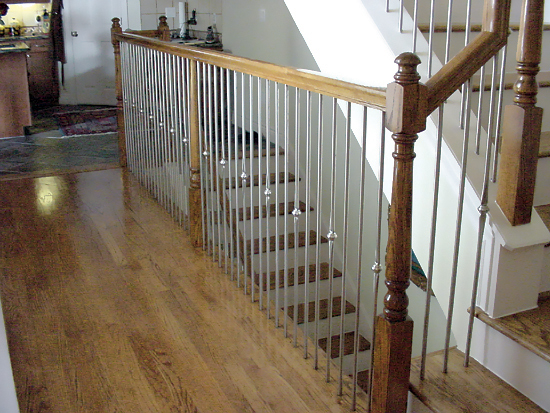
Many homeowners choose to retain their wooden handrails while replacing traditional wood spindles with decorative iron balusters.
This creates a new appearance without changing the overall staircase layout.
However, the handrail must meet several conditions.
It should be stable. A properly secured handrail should not move excessively during normal use.
The wood should be sound. Significant cracking, splitting, deterioration, or damaged connections may require repairs.
The dimensions should be suitable. The existing handrail must accommodate the selected balusters and their installation requirements.
The railing configuration should remain appropriate. Height, continuity, openings, and other relevant safety requirements must be considered.
A handrail may look attractive but still have loose or inadequate connections.
That is why its appearance alone should not determine whether it can remain.
If the handrail is secure and compatible with the replacement components, keeping it is often a practical choice.
Can Existing Newel Posts Be Reused?
Newel posts are the larger supporting posts commonly found at the beginning and end of stair runs, along landings, or where the railing changes direction.
Their condition is particularly important because they help anchor the railing system.
When these posts are stable and properly attached, they can often remain during a baluster replacement.
For example, a staircase with traditional wooden newel posts may work well with new black iron balusters.
You can preserve the original wood details while giving the railing a more updated appearance.
However, newel posts should be assessed for:
Movement or looseness at the base
Cracks or structural damage
Deteriorated wood
Damaged mounting connections
Inadequate support for the proposed railing configuration
A loose newel post is not the same as a loose baluster.
Replacing the balusters will not necessarily correct problems with a post that anchors the handrail.
If the posts are damaged or improperly secured, repairs or replacement may be necessary.
When Are Baluster Problems Mostly Cosmetic?
Not every sign of wear indicates a structural problem.
Some balusters remain functional but no longer match the homeowner's preferences or the surrounding interior.
Cosmetic concerns may include:
Outdated profiles: Traditional turned wood spindles may look too decorative for a recently updated home.
Worn paint or stain: Minor surface scratches, fading, or discoloration may affect appearance without compromising the baluster's condition.
Mismatched designs: Previous repairs may have introduced replacement spindles that do not match the original railing.
Unwanted decorative patterns: A homeowner may prefer simpler balusters instead of ornate designs.
For cosmetic concerns, you may have more than one option.
Refinishing the existing balusters could be sufficient if you like their shape and they remain in good condition.
If you want a different appearance, replacing them with another style may make more sense.
For example, switching from white wooden spindles to straight black iron balusters can change the character of a staircase while retaining the existing wooden handrail.
However, cosmetic improvements should come after confirming that the railing is stable.
A fresh finish or new baluster pattern cannot correct underlying structural problems.
What Structural Problems Require More Than Baluster Replacement?
Some staircase conditions go beyond the balusters themselves.
When supporting components are damaged or unstable, replacing the spindles alone may leave the main problem unresolved.
Damaged or unstable handrails
A handrail that is cracked, severely deteriorated, or improperly secured may require repair or replacement.
The new balusters cannot compensate for a handrail that fails to provide appropriate support.
Loose newel posts
If a newel post moves at its base, the problem may involve its mounting hardware or the supporting structure.
This should be evaluated before new balusters are installed.
Damaged stair treads or supporting wood
Certain baluster installations rely on the condition of the stair treads or surrounding woodwork.
If those surfaces are cracked, deteriorated, or unsuitable for secure attachment, additional repairs may be needed.
Incorrect railing configuration
Some existing railings may have unsuitable heights, openings, or connection arrangements.
Depending on the extent of the problem, the solution could involve modifying or replacing more than the balusters.
Widespread deterioration
When multiple railing components show significant damage, a larger remodel may be more practical than repairing each part separately.
A full staircase remodel is not always necessary. Sometimes only the railing system needs substantial work.
The important distinction is whether the existing components can safely support the proposed upgrade.
How Railing Movement Can Signal a Larger Issue
One warning sign homeowners should take seriously is movement in the railing.
A single loose baluster may indicate a localized attachment problem. However, movement involving the handrail or newel posts can suggest a more significant concern.
Pay attention to where the movement occurs
Different types of movement can point to different problems.
One baluster moves: The issue may be limited to its connection or mounting location.
Several balusters move together: There may be a shared connection problem or movement in the surrounding railing.
The handrail shifts: Its support or attachment points may need attention.
A newel post moves at the base: The connection to the supporting structure may be compromised.
These observations do not establish a diagnosis, but they help identify what a professional should examine.
Do not rely on an unstable railing
If your railing leans, shifts noticeably, or feels loose when used, avoid relying on it for support until it has been assessed.
Do not attempt to determine its strength by repeatedly pushing or pulling against it.
A contractor can inspect the affected connections and determine whether localized repairs, new components, or a larger railing replacement is appropriate.
Safety should always take priority over preserving existing materials or reducing remodeling costs.
How to Decide Between Baluster Replacement and a Full Remodel
The right choice depends on which parts of your staircase need attention and what you want to accomplish.
If the main concern is appearance, replacing the balusters may be enough.
If the railing has structural problems or you want to change its entire configuration, a more extensive project may be necessary.
Here is a practical comparison:
Existing staircase condition
Possible approach
Outdated baluster style with a secure railing
Replace or refinish balusters
One or two damaged balusters
Evaluate individual replacement
Multiple worn balusters with sound handrails and posts
Consider replacing the baluster set
Loose handrail or newel posts
Professional assessment and necessary repairs
Damaged supporting wood or mounting locations
Repair affected structure before installation
Major changes to railing shape or layout
Consider a larger railing remodel
Widespread structural deterioration
Evaluate substantial repair or replacement
Consider your long-term plans
Before deciding, think about whether you are satisfied with the overall staircase.
If you like your wooden handrail and newel posts, a baluster replacement may deliver the improvement you want.
However, if you eventually plan to replace the handrail, change the railing height, or install a completely different design, completing those changes together may avoid repeated work.
Compare the actual scope of repairs
A limited replacement is often less expensive than a full railing remodel, but that is not always the case.
If substantial repairs are required to reuse the existing components, replacing more of the railing system may be worth considering.
A professional assessment can help identify which components are suitable for reuse and which need attention.
The goal is not to choose the smallest project at any cost. It is to complete the work necessary for a safe, functional, and attractive staircase.
Stair Railing Upgrades in Charlotte, NC
Many homeowners in Charlotte have traditional wooden staircases with handrails and newel posts that may still be in good condition.
When the balusters are outdated or damaged, replacing them can refresh the staircase without changing its original structure.
For example, a home with oak handrails and turned wood spindles may benefit from a more streamlined iron baluster pattern.
However, staircases in older or previously remodeled homes may have variations in their dimensions, mounting methods, or existing railing conditions.
These differences should be evaluated before selecting replacement components.
Find Out What Your Staircase Needs With Master Fabrication
At Master Fabrication, we help homeowners in Charlotte, NC, and surrounding communities update their stair railings through iron baluster replacements, custom railing work, and staircase railing renovations.
We understand that you may want to improve your staircase without replacing components that are still in good condition.
When your existing handrail and newel posts are suitable for reuse, replacing the balusters may be an effective way to achieve a different appearance.
If the railing has more extensive problems, it is important to identify those concerns before moving forward with a cosmetic upgrade.
Through our in-person design consultations, we can review your existing staircase, discuss available baluster styles, and help determine the appropriate scope of railing work.
Contact Master Fabrication today to request a consultation and explore whether your staircase needs new balusters or a larger railing upgrade.
FAQs About Replacing Stair Balusters
Can I replace stair balusters without replacing the entire railing?
Yes. If the existing handrail, newel posts, and supporting structure are sound and compatible with the replacement components, you can often replace the balusters without removing the entire railing.
Are loose stair balusters dangerous?
Loose balusters may reduce the effectiveness of the protective barrier along your staircase. The level of risk depends on the location, number of affected components, and condition of their connections. Have loose balusters evaluated before continuing normal use of the affected railing.
Is it cheaper to replace balusters or remodel the staircase?
Replacing balusters is generally less expensive when the existing handrail and posts can remain. However, significant damage, unusual dimensions, or additional repairs can affect the final cost.
Can damaged wooden balusters be replaced with iron?
Yes. Many wooden balusters can be replaced with iron components when the existing railing is suitable. The new balusters must be correctly measured, securely installed, and arranged with appropriate spacing.
Does a loose handrail mean I need a full staircase remodel?
Not necessarily. A loose handrail may require repairs to its connections or supporting posts rather than a complete remodel. A professional evaluation can determine the cause and appropriate repair.
Should I replace all my balusters if only a few are damaged?
Not always. Individual replacement may be possible when damage is isolated and compatible materials are available. Replacing the entire set may make more sense when several balusters are deteriorated or you want a consistent new design.
How do I know if my existing newel posts are still good?
Newel posts should be securely attached and free from significant structural damage. If they move, show cracking, or have deteriorated mounting connections, have them professionally assessed before replacing the balusters.