
Stair Railing Ideas for Transitional Homes
The best stair railing ideas for transitional homes combine traditional warmth with cleaner, more modern lines. Instead of leaning heavily toward ornate detailing or ultra-minimal metalwork, transitional railings use balanced proportions, simple iron patterns, wood accents, and versatile finishes that can work with a wide range of interiors.
At Master Fabrication, we often see transitional staircases work best when no single element dominates the design. Warm wood can soften dark metal, simple baluster patterns can add structure without looking stark, and carefully chosen finishes can connect the staircase to the flooring, trim, lighting, and hardware throughout the home.
What Does Transitional Stair Railing Design Mean?
Transitional design brings traditional and modern elements together in a way that feels comfortable, polished, and long-lasting.
For stair railings, that usually means taking familiar materials such as wood and iron and simplifying how they are used.
A highly traditional staircase might feature carved newel posts, ornate scrollwork, decorative balusters, and dark stained wood. A strongly modern staircase may use very slim metal components, cable, glass, or sharp geometric lines.
A transitional railing generally sits between those two extremes.
Common features include:
Clean wood handrail profiles
Simple or lightly detailed iron balusters
Square or subtly shaped newel posts
Black, bronze, or neutral metal finishes
Warm wood tones
Controlled use of decorative details
Consistent spacing and repetition
Coordination with surrounding finishes
The result should feel familiar without looking dated and contemporary without feeling cold.
That balance is what makes transitional railing design so versatile.
Which Railing Profiles Work Best in Transitional Homes?
The overall profile of the railing has a major effect on its style.
For transitional interiors, profiles should usually be clean but not overly sharp or minimal.
Simple Wood Handrails
A smooth wood handrail with a modest amount of shaping works well because it provides traditional warmth without introducing too much ornamentation.
Extremely carved or bulky profiles may feel too formal, while very thin rails may push the staircase toward contemporary design.
A medium-weight profile often creates the right middle ground.
Straight Metal Rails
Straight horizontal and vertical lines help give transitional staircases a more updated appearance.
Metal components with consistent proportions can make traditional wood features feel lighter and more current.
Square Newel Posts
Square newels are especially useful in transitional interiors.
They feel substantial enough for classic architecture but clean enough to work with simplified metalwork.
A plain square post can be left almost completely unadorned or given subtle trim details depending on the rest of the home.
Softly Detailed Profiles
Small changes in edge shape, cap design, or handrail contour can add interest without turning the staircase into an ornate focal point.
In transitional design, small details often work better than dramatic ones.
What Iron Baluster Patterns Fit a Transitional Style?
Iron balusters are one of the easiest ways to control where a staircase falls between traditional and modern.
Simple patterns usually provide the most flexibility.
Straight Balusters
Straight vertical iron balusters are a strong foundation for transitional homes.
They create repetition and structure while allowing wood components and architectural details elsewhere in the room to stand out.
They can be used throughout the staircase or combined with a small number of accent balusters.
Straight Balusters With Simple Knuckles
A single knuckle or restrained center detail can add traditional character without making the railing feel ornate.
This works especially well in homes where moldings, cabinetry, or lighting already have subtle classic influences.
Light Twist Patterns
Occasional twisted balusters can provide visual texture.
The key is moderation.
Using a twist sparingly among mostly straight balusters keeps the railing balanced rather than decorative.
Simple Geometric Patterns
Clean geometric ironwork can also fit a transitional interior, particularly if the home leans slightly more modern.
Rectangles, diamonds, and uncomplicated repeating forms can bring visual interest without relying on elaborate scrollwork.
Custom Restrained Metalwork
Custom fabrication allows homeowners to create a pattern that reflects the architecture of the house without using an overly recognizable or trend-driven design.
At Master Fabrication, we often find that the most successful transitional patterns are distinctive because of their proportions and repetition rather than the number of decorative elements they contain.
How to Use Wood Accents Without Making the Design Feel Too Traditional
Wood is an important part of transitional design because it brings warmth to metal.
The challenge is using enough wood to soften the staircase without making the design feel overly formal or traditional.
One of the simplest approaches is to use wood selectively.
For example:
Wood handrail with iron balusters
Wood newel posts with simple metal infill
Wood treads paired with dark metal railing components
A wood cap rail over a mostly metal railing
These combinations introduce warmth while preserving clean lines.
The wood finish also matters.
Very dark, glossy stains can make a staircase feel more traditional, particularly when paired with decorative ironwork.
Medium or natural wood tones often feel more relaxed and transitional.
Lighter stains can move the design closer to modern, while deeper brown tones can introduce more classic character.
Another option is to keep the wood profile simple.
A straight, square newel post in a warm stain feels much more transitional than an extensively carved post in the same wood species.
Which Finish Combinations Create a Balanced Look?
Transitional interiors usually benefit from finish combinations that feel familiar rather than extreme.
Popular combinations include:
Matte black metal with medium-tone wood
Soft black metal with natural oak
Dark bronze with warm brown wood
Charcoal metal with lighter neutral wood
Black iron with stained treads and painted newels
Neutral metal finishes with warm painted trim
The goal is contrast without making the staircase look disconnected from the room.
Black metal is particularly useful because it can introduce definition while remaining neutral enough to coordinate with a wide range of styles.
Dark bronze can soften the contrast slightly and may work especially well in interiors with warmer flooring, beige tones, brass accents, or traditional furniture.
Wood tones can also bridge different finishes.
For example, a staircase with black iron balusters and warm wood handrails may connect naturally to both black door hardware and brown hardwood floors.
This ability to bridge different design influences is one of the strengths of transitional style.
How to Mix Black Metal With Warm Wood Tones
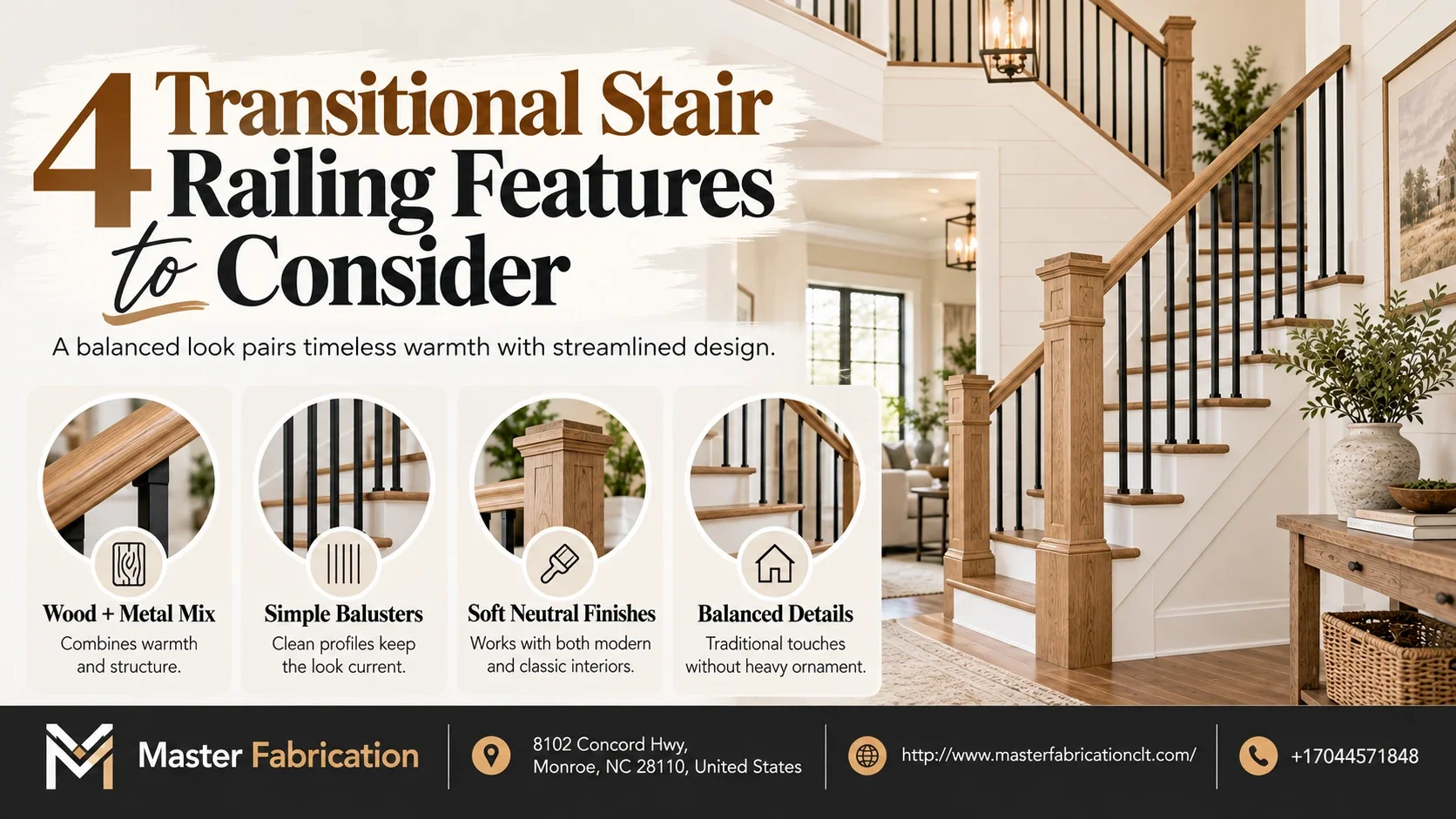
Black metal and warm wood are one of the most reliable combinations for transitional staircases.
The metal creates structure and contrast, while the wood prevents the design from appearing too severe.
The trick is deciding how much of each material to use.
For a warmer look, homeowners might choose:
Wood handrail
Wood newel posts
Wood treads
Black iron balusters
This allows wood to remain visually dominant while the metal introduces a cleaner edge.
For a more modern interpretation, the balance can shift toward metal.
A staircase might use:
Slim black metal balusters
Simple metal posts
A warm wood handrail
Coordinating wood stair treads
The railing still feels residential and inviting, but the overall appearance becomes lighter.
The undertone of the wood is also important.
Golden, neutral, and medium brown tones often pair naturally with black. Extremely red or orange stains may require more careful coordination with flooring and furniture.
It helps to compare railing samples directly against the wood already present in the room.
How to Keep the Staircase Looking Timeless
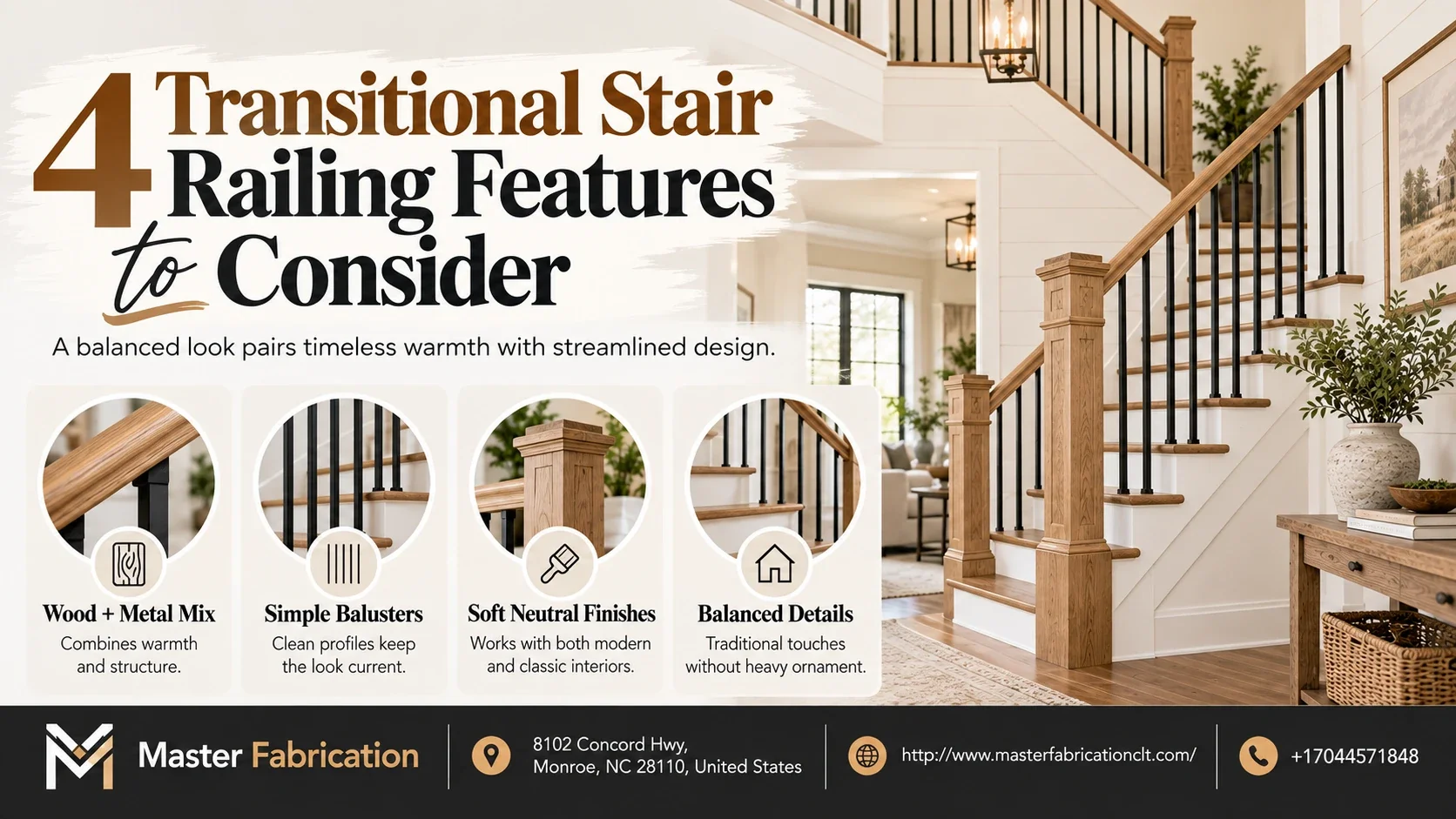
Transitional design works best when the staircase does not depend too heavily on a single trend.
Bold design choices can make a strong first impression, but railings are architectural features that typically stay in place for many years.
A timeless staircase usually relies on proportion, material quality, and repetition rather than novelty.
To keep the design balanced:
Limit the number of baluster styles
Avoid overly complex patterns
Choose versatile metal finishes
Use wood tones that work with permanent flooring
Keep newel posts relatively simple
Avoid mixing too many competing materials
Repeat visual details consistently
Consider how the railing will look if nearby furnishings change
A railing should still make sense even if wall colors, furniture, or light fixtures are updated later.
That is one reason black iron, warm wood, and simple repeating forms continue to work so well.
They are easy to adapt to different interiors without feeling tied to one short-lived design trend.
How to Coordinate Railings With Floors, Trim, and Hardware
The staircase is often visible from several areas of the home, so its finishes should relate to more than the immediate stairwell.
Flooring
Start with the flooring because it is usually one of the largest permanent surfaces.
The railing wood does not need to match the floor exactly, but the tones should work together.
If the flooring has warm brown undertones, a similarly warm handrail can create continuity.
If the flooring is lighter and more neutral, a medium wood handrail can introduce contrast without looking unrelated.
Trim
White or off-white trim pairs easily with transitional railings.
Painted trim can also help separate wood tones so homeowners do not feel pressure to match every piece of wood in the room.
If the home has substantial traditional trim or wall molding, simpler railing components may provide a useful visual counterbalance.
Hardware
Look at door handles, cabinet pulls, plumbing fixtures, and nearby furniture.
Black railing components can connect with black hardware throughout the home.
Bronze or warmer metal finishes may work better if the house already includes brushed brass, warm nickel, or brown-toned hardware.
Exact matching is not always necessary.
The finishes simply need to feel intentional together.
Lighting
Lighting fixtures are especially important around staircases because chandeliers and pendants are often positioned directly above them.
If the light fixture is highly decorative, keeping the railing simpler can prevent the area from becoming busy.
If the fixture is minimal, the railing can carry slightly more detail.
Think about the staircase and lighting as one visual composition.
Common Transitional Railing Design Mistakes
Because transitional design mixes styles, it can become inconsistent if too many ideas are introduced at once.
Using Too Much Traditional Ornamentation
Scrolls, baskets, twists, carved posts, and dark wood may each work individually.
Using all of them together can turn a transitional staircase into a fully traditional one.
Choose only one or two subtle classic details.
Going Too Minimal
The opposite problem can happen as well.
Extremely thin metalwork, sharp geometric forms, or a completely industrial appearance may feel disconnected from a home with traditional moldings and warm finishes.
A little visual weight can help the staircase remain comfortable and residential.
Mixing Too Many Metal Finishes
Transitional homes can mix metals successfully, but too many competing finishes within the staircase itself can create visual clutter.
Choose one primary railing finish and allow other metals in the room to act as accents.
Matching Wood Too Closely
Trying to make every wood surface identical can sometimes produce an unnatural result.
A coordinated palette usually looks better than forcing the handrail, floor, furniture, and cabinetry into one exact stain.
Choosing a Pattern Before Considering the House
A baluster pattern may look attractive by itself but still feel wrong once installed.
Always evaluate the pattern alongside the home's trim, flooring, ceiling height, lighting, and overall architecture.
How to Choose a Railing Style That Fits Your Home
Start by identifying which side of transitional design your home already leans toward.
If the interior includes detailed trim, traditional cabinetry, warm hardwood, and classic lighting, a slightly cleaner railing can help modernize the space.
Simple black balusters and square newel posts may provide enough contrast.
If the house is already modern with flat-panel cabinetry, open spaces, and minimal trim, adding warm wood handrails or slightly more substantial posts can keep the staircase from feeling too stark.
Consider the following before choosing the design:
Existing floor color
Trim and molding style
Ceiling height
Staircase width
Natural light
Hardware finishes
Cabinetry
Nearby furniture
Architectural details
How visible the stairs are from adjoining rooms
Then decide which element should provide the personality.
It might be the wood grain.
It might be the baluster pattern.
It might be the contrast between dark metal and light surroundings.
Not every element needs to compete for attention.
At Master Fabrication, we approach transitional railing design as a balancing exercise. Custom metalwork allows the railing to respond to the architecture already in place instead of forcing the home into one specific style.
The goal is a staircase that feels updated today but still looks appropriate as the rest of the interior evolves.
FAQs
What type of railing works best in a transitional home?
A combination of simple iron balusters, clean wood handrails, and understated newel posts works well in many transitional homes. The design should balance traditional warmth with more streamlined profiles.
Are black stair railings good for transitional interiors?
Yes. Black is versatile and works especially well when paired with warm wood. It can make traditional architectural details feel more current without pushing the room into a fully modern style.
Can transitional railings include decorative ironwork?
Yes, but decorative elements are usually most effective when used sparingly. A few simple knuckles, twists, or geometric accents can introduce detail while keeping the railing restrained.
Should the stair railing match the floor?
It does not have to match exactly. The wood tone should complement the flooring and share compatible undertones, but slight variation can make the interior feel more layered and natural.
Is wood or metal better for a transitional staircase?
Neither material needs to be used exclusively. Transitional designs often work best when wood and metal are combined. Wood provides warmth and familiarity, while metal introduces clean lines and visual contrast.
How can I prevent a transitional railing from looking dated?
Focus on simple proportions, restrained patterns, versatile finishes, and durable materials rather than highly specific trends. A clean wood-and-metal combination can adapt more easily as surrounding décor changes.
Create a Transitional Stair Railing That Feels Balanced
The most successful transitional stair railings do not force homeowners to choose between traditional warmth and modern simplicity.
They combine the two.
A warm wood handrail can soften black iron. Straight balusters can update a classic staircase. A subtle custom metal pattern can add personality without overwhelming the architecture. When those materials, finishes, and proportions are carefully coordinated, the staircase becomes part of the home's overall design rather than a separate decorative feature.
At Master Fabrication, we can create custom metal railing components designed around the architecture and finishes already present in your home. Whether you prefer a slightly traditional appearance, a cleaner modern direction, or something directly between the two, thoughtful fabrication can help create a staircase that feels balanced, refined, and built to last.